|
Themes |
|
Working conditions |
|
Well-being and engagement |
|
Inclusion, diversity, and equity |
Our impact and strategy
Only through our people can we live our promise: to inspire confidence and empower change. Driven by this promise, we work to deliver the highest-quality services to our clients, led by five values – Integrity, Excellence, Courage, Together, For Better – that define our expectations of one another and, above all, of ourselves. We are committed to integrating these values into our day-to-day work at KPMG and to creating a psychologically safe workplace where our people feel included and are encouraged to ask questions, experiment, and learn.
We also recognize that, to uphold high quality standards and to attract and retain professionals, we must pay continuous attention to the challenges they face and provide appropriate support. Our people work hard to deliver high-quality services, and we acknowledge that tensions may arise between the expectations inherent in our high-performance culture and the need to minimize negative impacts on our workforce.
Our workforce is also affected by external factors such as the growth of AI and the proposed Omnibus changes to EU reporting requirements. We therefore face changes in the way we work, as well as an increasing need to build resilience to protect the well-being of our people, both on a day-to-day basis and in the long term. The positive and negative impacts we have on our workforce, as well as the risks we face if we do not nurture, support, and inspire our people, are central to our sustainability and business performance. How we care for our people shapes our culture. We aim to foster a safe and inclusive environment that encourages innovation and has a positive impact on both our clients and society.
Managing our workforce-related sustainability matters is therefore a top priority for our firm. We have dedicated teams and structures in place for key areas such as Culture, Diversity, Equity & Inclusion, Well-being, and Learning & Development. These teams are key drivers behind fostering our culture and values as well as the well-being and development of our professionals.
In this section, we outline the key policies, actions, metrics, and targets we use to manage material impacts, risks, and opportunities (IROs) and mitigate any adverse effects related to our own workforce. We have grouped our 9 material matters under three themes: working conditions, well-being and engagement, and inclusion, diversity, and equity (IDE). For more information on these sustainability matters, see Table 2 in “Results of our DMA review” in the General information chapter.
|
S1 Own workforce |
Impact materiality |
Financial materiality |
Value chain |
||
|
Emission category |
Positive |
Negative |
Opportunity |
Risk |
|
|
Working conditions |
|||||
|

|

|
|||
|
|
|
|||
|
Well-being and engagement |
|||||
|
|
|
|||
|
|
|
|||
|
|
|
|||
|
|
|
|||
|
|
|
|||
|
Inclusion, diversity, and equity |
|||||
|
|
|
|||
|
|
|
|||

|
|||||
Our own workforce includes professionals working for us under permanent or fixed-term employment contracts, including non-equity partners and inbound expats. Non-employees are professionals otherwise affiliated with KPMG, such as equity partners, contractors, offshore resources, and interns.
Overarching approach
Our policies are designed to address potential negative impacts and risks while providing a framework that supports our people in developing their talents and reaching their full potential. Details of policies for managing specific material IROs can be found in the relevant thematic section below. All policies are available on our intranet, where any significant updates are also announced.
We have also defined key metrics and targets to measure our performance. These targets enable us to proactively monitor progress, address areas of concern, and steer actions aimed at driving continuous improvement. Relevant metrics and targets for each sub-topic are disclosed in the thematic sections on the next pages.
Human rights
Human rights impacts across the global KPMG network are monitored as part of our Global Quality & Risk Management processes. KPMG has adopted the KPMG International Human Rights Statement, which aligns with the United Nations (UN) Guiding Principles on Business and Human Rights (UNGPs). This reflects our commitment to respecting human rights and builds on our longstanding support for the UN Global Compact. The KPMG International Human Rights Statement commits us to upholding the UNGPs by avoiding causing or contributing to adverse human rights impacts through our own activities and by addressing such impacts when they occur.
KPMG International’s Global Code of Conduct, which also applies to KPMG, includes a commitment to the 10 principles of the UN Global Compact, including human rights. These 10 principles are embedded in our Impact Plan (see “Value created through our Impact Plan”). The Global Code of Conduct reaffirms our commitment to zero tolerance for behavior, including by clients, suppliers, or public officials, that is illegal, unethical, or in breach of human rights (see “Inclusion, diversity, and equity”).
Other policies implemented at KPMG are consistent with the UN Declaration on Human Rights, the UNGPs, the International Labour Organisation’s Core Conventions, and the Organisation for Economic Co-operation and Development’s Guidelines for Multinational Enterprises.
The KPMG International Hotline serves as a confidential and accessible channel that enables members of our own workforce to report concerns or misconduct, including potential adverse human rights incidents. We also have several internal hotlines and complaint logging procedures.
Reporting and remediating negative impacts
We believe that psychological safety is essential for mitigating negative impacts on our own workforce’s mental health, well-being, and engagement. As part of our approach to creating a psychologically safe working environment at KPMG, we are committed to addressing and preventing any undesirable behavior. Undesirable behavior is defined as any conduct perceived as such by the individual, including but not limited to bullying, inappropriate jokes, (micro)aggressions, intimidation, all forms of discrimination, and sexual harassment.
To support this, we have established a "Safety net" of grievance mechanisms for colleagues who experience or witness undesirable behavior or work-related disputes. Available channels include a whistleblowing hotline, confidential counselors, mediators, and the Complaints and Disputes Committee (see Table 14). These channels are described on our intranet (InsideOut) and the KPMG International website and are regularly communicated via the intranet, integrated reports, and email updates.
The Board of Management ensures that employees and non-employees can report alleged irregularities without fear of retaliation, and the Supervisory Board is immediately informed of any signs of critical concerns within KPMG. Together with the confidential counselors and mediators, the Complaints and Dispute Committee presents an annual report to the Board of Management on the cases handled throughout the year, including recommendations for further process improvements.
|
Safety net component |
Description |
|
Whistleblowing hotline |
The hotline is available not only to our workforce but also to clients, suppliers, and other business partnes. It enables people to confidentially report possible illegal, unethical, or otherwise unprofessional conduct, when regular communication channels are ineffective or difficult to access. Reports are received and handled by the Internal Audit & Compliance Office, which, if necessary, coordinates with the Country Risk Management Partner and the General Counsel of KPMG. A report is generally handled within three months, with interim communication if it takes longer. All reports are treated confidentially, in accordance with applicable legislation and regulations. We also ensure protection for the reporting party. |
|
Confidential counselors |
KPMG has nine confidential counselors (seven internal, two external) available to our people, including our employees and our non-employees working in the Netherlands. Access to internal and external conficential counselors is via the intranet. These counselors offer confidential guidance and assistance to colleagues, particularly in situations involving undesirable behavior. Where necessary, they may accompany the colleague in conversations and/or involve an independent third party (mediator) to help reach a solution. |
|
Mediators |
We have two internal mediators who can be contacted directly or via a confidential counselor. The mediator facilitates a conversation between two people, following a formal process to ensure that both sides are heard and that a fair and equitable outcome is achieved. |
|
Complaints and Disputes Committee |
The committee consists of six people and was established by the Board of Management and the Works Council. It addresses undesirable behavior and labor disputes. Our people, including both employees and non-employees working in the Netherlands, can raise concerns with this committee regarding, for example, their work, terms of employment, development, or any instances of undesirable behavior that cannot be resolved through open dialogue. Upon receiving a complaint related to undesirable behavior, the committee provides advice to the Board of Management, which then determines the appropriate course of action. For other types of complaints, the committee may act at its own discretion. This ensures the appropriate consultation and diligence, ensuring suitable outcomes and support for all parties involved. |
Table 14
We consider it a positive sign that our people feel comfortable raising matters through our safety net. To ensure this remains the case, we evaluate the effectiveness and appropriateness of our grievance mechanisms several times per year. Over the past year, we continued to implement recommendations based on psychological safety research (2022/2023) and analysis or reported instances of undesirable behavior.
To ensure we provide effective remedies and appropriate mechanisms for raising concerns, our safety net consists of multiple channels, including confidential counselors, mediators, the Complaints and Disputes Committee, and a whistleblowing hotline. The security of the net is continuously reviewed. Over the past year, we continued implementing recommendations based on psychological safety research (2022/2023) and an analysis of reported instances of undesirable bahavior, including answer sharing.
Building on these insights, we have continued with process improvements such as:
Annual psychological safety measurement via the GPS, complemented by cultural entropy analysis (Engagement and Undesired Behavior scores) and psychological safety heatmaps.
Targeted team support where GPS results indicate room for improvement.
Enhanced grievance mechanisms, evaluated several times per year for effectiveness and accessibility.
We also have embedded psychological safety within the Values First Program, making it a cornerstone of our cultural transformation. For more information about the Values First Program, see section "Putting our Values First" in the management review.
Working conditions
|
Sustainability matters |
Key policies |
|
Employee attraction and retention |
Remuneration Policy |
|
Training and education for our own workforce |
Global Quality & Risk Management Manual |
|
Targets |
Key actions |
|
85% retention in Assurance |
Developing a new benchmark methodology |
|
82% retention in Advisory 85% retention in Central Services |
Improving our talent attraction and selection process with high-end tech solutions |
|
20 permanent education hours for client-facing professionals |
Focusing on follow-up and optimization of identified reward topics |
|
160 hours annually per audit professional 100% completion of mandatory integrity training |
Establising a modernized and bias-free talent attraction and selection process to enlarge our talent pools |
|
Equiping employees with tailored skills and capabilities on AI and ESG, and meeting the mandatory learning requirements |
|
|
Launching employer branding campaign "Het blijft mensenwerk" |
Ensuring positive working conditions for employees is essential to achieving our business objectives. KPMG has a workplace accident management system in place to prevent physical risks to the health of our own workforce. Alongside this, we place particular emphasis on supporting mental health and well-being, due to the nature of our activities and operations (see section “Well-being and engagement”).
Within the area of working conditions, our DMA process identified talent attraction and retention and training and education as key sustainability matters. These factors are critical to KPMG maintaining a motivated and capable employees, both now and in the future. In each of the following sections, we outline how our policies, actions, metrics, and targets enable us to effectively manage and improve our performance in these areas.
Employee attraction and retention
Key policies and actions
|
Policy name |
Key contents |
|
Remuneration Policy |
The policy includes primary compensation, along with secundary benefits, to ensure our employees receive an attractive compensation package in a highly competitive market. |
|
Terms and conditions of employment |
KPMG offers a comprehensive leave scheme to support employees in balancing their professional and personal lives. The terms and conditions of employment cover statutory and additional leave types, including holidays, special occasions, and care and parental responsibilities. Employees can also request part-time work or adjust their working hours, in consultation with their manager, to better suit their personal needs and circumstances. |
Our approach to ensuring that KPMG remains an attractive employer in the market is built on providing meaningful work and personal and career development opportunities. This is supported by our policies, which are designed to enhance employee opportunities and experiences.
We apply an integrated approach to talent attraction and retention that also encompasses learning and development, performance management, rewards and recognition, and IDE. Our actions to retain employees and remain an employer of choice often also address material IROs related to our own workforce.
For example, we are modernizing our recruitment process with bias-free, technology-enabled tools and a focus on skills-based hiring, in order to ensure inclusive recruitment and selection. This includes our business and hiring teams working more closely together to create a compelling candidate experience and ensure alignment with our long-term workforce needs.
We also launched a human-centric employer branding campaign in 2025, differentiating our firm from competitors and lowering the threshold for potential candidates to engage with KPMG. By emphasizing authenticity, inclusivity, and accessibility, the campaign is designed to attract talented individuals who might not have previously considered joining us.
Ensuring adequate compensation for our workforce is an important element of employee attraction and retention. Under our Reward Refresh initiative, we are updating our vision and strategy on rewards. Our goal is to maintain a competitive approach that aligns with KPMG’s values.
Another key action is our work to improve the accessibility and relevance of our learning curriculum, particularly for Development Managers. We took this action with the objective of further strengthening the role of development managers in the personal and professional development of our workforce, ensuring it supports goal-setting, performance management, and long-term career development for our workforce. We are also implementing initiatives focused on the health and well-being of employees and non-employees in the Netherlands.
At KPMG, employees are empowered to take ownership of their professional development from the outset. KPMG provides an environment that encourages continuous growth, both personally and professionally. Through exposure to a spectrum of specializations, assignments, and innovations, employees are offered opportunities to accelerate their development.
When it comes to promotions, KPMG supports employees who wish to explore the boundaries of their talents and aspire to advance within the organization. Career progression may involve transitioning to a new role or further specialization, depending on individual development and ambition. Continuous development is a core value at KPMG, as it benefits both the individual employees and the organization.
Metrics, targets, and performance
KPMG sets clear targets for each business line (see below). External developments, such as labor market dynamics and the rapid advancements of AI, may also impact employee retention in the coming years. KPMG actively monitors these trends and adapts its policies and development programs accordingly, ensuring that employees are supported in their ambitions, professional growth, and sustainable employability.
Investing in our employees and maintaining a high-performing workforce strengthens our position as an attractive employer. We recognize that actively engaging with employees and consistently listening to their needs contributes to their development, well-being, and retention. We therefore track and assess the effectiveness of our actions through regular pulse surveys and our GPS.
We also monitor the effectiveness of our actions by assessing our performance against attraction and retention targets. Target-setting for workforce-related metrics is embedded in KPMG’s annual business plan process, which is led by the CHRO in close collaboration with the Leadership Teams of Advisory, Assurance, and Central Services. Based on prior-year results, future ambitions, and anticipated developments, the HR Leadership Team proposes targets that are then discussed with and approved by the Board of Management.
When setting the retention target for 2024/2025, labor market dynamics were a key consideration. At that time, the market was more competitive, which was reflected in the retention figures for 2023/2024 which were below the original target of 84% for Advisory and 85% for Assurance. As the rapid cooling down of the labor market was not anticipated, the 2024/2025 target for Advisory was deliberately set lower at 82%, to ensure a realistic expectation. The targets for Assurance and Business Services remained unchanged. The current higher retention rate is therefore primarily the result of an unexpectedly softened labor market.
We have established entity-specific targets for the retention of client-facing employees in Advisory and Assurance. Equity partners are included in these targets, which are monitored quarterly. Inbound expats are excluded, as their departure is considered planned and therefore provides limited insight into long-term employee retention at KPMG.
|
Retention performance |
Target 2024/2025 |
2024/2025 |
2023/2024 |
|
Assurance |
85.0% |
84.7% |
82.0% |
|
Advisory |
82.0% |
84.1% |
82.5% |
|
Central Services |
85.0% |
86.8% |
84.9% |
Table 15
In response to the ongoing challenges in the labor market, we remain commited to retaining our employees. Through targeted initiatives and a consistent focus on employee engagement, retention rates improved in 2024/2025 compared to the previous year. This progress is evident across all business lines. The figures presented in the table demonstrate above show that our efforts contribute to a more stable and engaged organization.
We also measure our employee turnover and the distribution of leavers. Unlike retention performance, these metrics exclude equity partners and include inbound expats. The data provided here on employee turnover and leaver distribution is based on a definition that differs from the one we use internally for steering and reporting purposes; as such, we have no defined targets linked to these metrics. The effectiveness of our policies and actions to manage this sustainability matter is measured via our entity-specific retention targets.
|
Employee turnover |
2024/2025 |
2023/2024 |
|
Assurance |
17.8% |
21.1% |
|
Advisory |
16.6% |
18.2% |
|
Central Services |
13.3% |
15.6% |
Table 16
Compared to 2023/2024, employee turnover decreased in 2024/2025 in all business lines, reflecting the impact of our retention efforts. These improvements indicate a strengthening of our employee engagement and retention strategies. The decrease in turnover within Assurance is notable, given the ongoing tight labor market that continues to make professionals more inclined to explore opportunities outside the assurance domain.
|
Distribution of leavers (headcount) |
2024/2025 |
2023/2024 |
|
Distribution of leavers by gender |
||
|
Female |
307 |
363 |
|
Male |
407 |
435 |
|
Other |
0 |
0 |
|
Not reported |
0 |
0 |
|
Distribution of leavers by business unit |
||
|
Assurance |
383 |
443 |
|
Advisory |
257 |
272 |
|
Central Services |
74 |
83 |
|
Grand total |
714 |
798 |
Table 17
The distribution of leavers by business line in 2024/2025 was broadly consistent with the previous year. Of the total leavers, 43.0% were female (2023/2024: 45.5%). This represents a year-on-year decrease, although the departing group remains predominantly male. When looking at the total female population, the percentage of women leaving the organization decreased from 19.7% in 2023/2024 to 16.4% in 2024/2025. This highlights the importance of our continuing focus on retaining female employees. Across business lines, the proportion of leavers in Assurance decreased to 53.6% (55.5% in 2023/2024), while Advisory increased to 36.0% (34.1% in 2023/2024). The share of leavers of Central Services remained stable at 10.4% in both years. These figures indicate a slight proportional shift from Assurance to Advisory, while Central Services remained unchanged.
Every year, we set dynamic recruitment targets for Assurance, Advisory, and – to a lesser extent – Central Services. These targets are subject to adjustment throughout the year, based on market and economic conditions. Recruiting experienced professionals remains challenging in the current market, as technology, risk, and regulatory sectors are particularly affected by the scarcity of qualified people. Progress toward our total recruitment target is reported quarterly in the management report, which is discussed by the Board of Management and shared with the Supervisory Board.
Training and education for our own workforce
Key policies and actions
|
Policy name |
Key contents |
|
Global Quality & Risk Management Manual |
This policy sets out various training activities including on integrity and objectivity, professional competence and due care, professional behavior, and continuing professional development requirements. |
Lifelong learning is a key component of our employee value proposition at KPMG. Accordingly, we aim to create an inspiring learning environment that motivates our people and supports their continuous professional and personal growth. We also invest in our own workforce’s learning and development year after year; in 2024/2025, this amounted to EUR 14.4 million, up from EUR 13.4 million the previous year. These resources support our action plans to manage material IROs related to our own workforce. The average number of training hours per employee increased slightly from 127 hours to 133 hours.
Our learning programs offer a broad range of training opportunities that are essential for strengthening the skills and competencies of our workforce and ensuring compliance with legal, regulatory, and internal policy requirements. Responsibility for managing these programs is shared among our Learning & Development, Risk Management, and Audit Quality Professional Practice departments. We embrace a blended learning approach that combines e-learning, workshops, and intervision sessions to enhance critical thinking. This is applied to strategic topics such as environmental, social, and governance (ESG) issues, (including the Corporate Sustainability Reporting Directive (CSRD)), leadership, AI and digital skills, sales, ethics, and independence. Blended learning is available to all our employees and equity partners across Assurance, Advisory, and Central Services, with targeted (recommended) training provided where relevant.
To attract and retain diverse talent with varying career goals and aspirations, we are developing new career paths and encouraging specialization for specific roles. This aligns with our transition to a value-driven business model, where technology handles routine tasks, allowing employees to focus on more complex challenges. The opportunities this creates are emphasized during onboarding, particularly for younger people entering the workforce.
We conduct formal annual assessments to identify training needs and ensure regulatory compliance, focusing on strategic areas such as AI, ESG and CSRD, leadership, digital skills, sales, ethics, and independence. In response to prior challenges related to mandatory training and regulatory supervision, we took further steps during the year to strengthen our ethical culture and learning environment, spearheaded by the firm-wide Values First program (see section "Putting our Values First" in the management review).
We continue to broaden our client services by developing professionals who combine subject-matter expertise with digital capabilities. Training on digitalization and innovation, therefore, remains a key focus. In 2024/2025, we welcomed a number of young professionals to Assurance as part of our Digital & Innovation Traineeship, in line with our commitment to continuous learning and workforce development.
In particular, AI is a key driver of transformation within our digital workforce strategy. We are actively embedding AI into our learning and development curriculum to ensure that our people are equipped with the skills needed to thrive in a digitally enabled environment. This includes skill-based resourcing and the use of AI in recruitment and HR processes. To drive this transformation, a range of AI solutions and learning content, developed by the global KPMG network, is made available to our employees. The responsible use of AI is increasingly being embedded in our services, ways of working, and goal-setting and performance evaluations.
To support this, we rolled out AI workshops to partners and directors in 2024/2025, enabling senior leadership to engage directly with AI tooling and promote its adoption across teams. Meanwhile, our new Velocity platform acts as an internal AI app store, providing employees with access to AI agents that support operational efficiency and quality enhancement (see section “Value created for our clients” in the management review).
We are also expanding our ESG learning curriculum, in line with CSRD legislation and our own sustainability service offerings and our Impact Plan. In 2024/2025, we developed tailored ESG training modules to ensure relevant colleagues receive targeted training on sustainability, ESG, and regulatory developments, including the ESRS.
We regularly evaluate the effectiveness of our training curriculum, updating the content to reflect new regulations and the evolving needs of our business and clients.
Metrics, targets, and performance
Although learning and development are an integrated part of development management conversations, we have not established ESRS-specific targets on training and education, such as performance reviews or average training hours per employee (although we measure both; see below and on the next page). Instead, we focus on meeting mandatory education requirements. All client-facing professionals must therefore complete 20 permanent education hours of continuing education every year, and certified auditors must comply with the permanent education standards set by the NBA. Our audit quality indicators (AQIs) include a target of more than 160 training hours per year per audit professional (see section “Audit quality”).
|
Average training hours per employee |
2024/2025 |
2023/2024 |
|
Distribution by business line |
||
|
Assurance |
209 |
196 |
|
Advisory |
70 |
70 |
|
Central Services |
17 |
15 |
|
Distribution by gender |
||
|
Female |
121 |
114 |
|
Male |
142 |
137 |
|
Distribution by employee category |
||
|
Partner/Director |
57 |
66 |
|
Senior manager |
55 |
58 |
|
Manager |
77 |
76 |
|
Senior |
113 |
113 |
|
Junior |
255 |
229 |
|
Other |
9 |
7 |
|
Average training hours per employee |
133 |
127 |
Table 18
In 2024/2025, the average number of training hours per employee increased slightly compared to the previous year. This increase was primarily driven by Assurance, where the average rose to 209 hours (2023/2024: 196). In Advisory, the average remained stable at 70 hours, while Central Services showed a slight increase from 15 to 17 hours. The higher average in Assurance partly explains why male employees received more training hours on average (142 hours) than female employees (121 hours), as the business lines with the highest training hours – Assurance and Advisory – have a majority of male employees (57.2% and 60.2% respectively). In Central Services, where the majority of employees are female (57.4%), the average number of training hours per employee was relatively lower.
Differences in training hours can also be attributed to varying training demand and improved accuracy in the registration of training hours. For junior employees, the increase in hours resulted from enhanced communication about the learning curriculum. The rise in Central Services is linked to better positioning of training programs and the ongoing transformation within this department. The decrease in Partner/Director can be explained by the conclusion of the Ethics program, which had driven last year's increase.
The average training hours per client-facing professional in Audit was 221 hours in 2024/2025, compared to 218 hours in 2023/2024 (see section “Audit quality”). These figures are higher than the average training hours per employee in Assurance, as shown here; this metric includes non-client-facing staff and therefore lowers the overall average.
|
Percentage participation in regular performance and career development reviews |
2024/2025 |
2023/2024 |
||
|
Yes |
No |
Yes |
No |
|
|
Distribution by business line |
||||
|
Assurance |
92% |
8% |
86% |
14% |
|
Advisory |
88% |
12% |
86% |
14% |
|
Central Services |
92% |
8% |
91% |
9% |
|
Distribution by gender |
||||
|
Female |
90% |
10% |
87% |
13% |
|
Male |
90% |
10% |
86% |
14% |
|
Distribution by employee category |
||||
|
Partner/director |
97% |
3% |
99% |
1% |
|
Senior manager |
94% |
6% |
93% |
7% |
|
Manager |
96% |
4% |
95% |
5% |
|
Senior |
96% |
4% |
92% |
8% |
|
Junior |
77% |
23% |
69% |
31% |
|
Other |
92% |
8% |
92% |
8% |
|
Grand total |
90% |
10% |
87% |
13% |
Table 19
Regular performance and career development reviews are an integral part of our annual performance and development cycle. Most colleagues participated in a review during 2024/2025, except for recent joiners and those who transitioned from non-employee to employee status during the reporting period. Non-employees do not participate in the annual performance review.
Lower-than-budgeted employee turnover resulted in a larger population to manage and, consequently, a slight increase in participation in the year-end-review (YER) process, particularly among junior employees. Fewer juniors were hired in Assurance, which directly impacted YER participation. Our performance year runs from July 1 to June 30, meaning that new joiners starting in September or October are not included in this performance year. The increase in participation is therefore partly attributable to these timing and population effects.
Well-being and engagement
|
Sustainability matters |
Key policies |
|
Social dialogue within our own workforce |
Hybrid working support scheme |
|
Work-life balance for our own workforce |
Remote working from abroad scheme |
|
Mental health and safety for our own workforce |
Terms and conditions of employment |
|
Privacy for our own workforce |
Health & Hapiness Guide |
|
Non-discriminiation within our own workforce |
Psychological Safety Booklet |
|
Privacy Policy |
|
|
Regulations on Undesirable Behavior |
|
|
Targets |
Key actions |
|
Employee engagement score: 77% |
Implementing engagement channels, including surveys |
|
Satisfaction score: 74% |
Supporting people during life changes |
|
Psychological safety score: 73% |
Embedding Values First and emphasizing psychological safety |
|
Managing work volumes and promoting predictability, teaming, and open communication |
|
|
Adapting processess to support equal opportunities |
|
|
Providing training and tools to tackle discrimination and bias |
Our workforce operates in a dynamic, high-performance setting, which, if not properly managed, can negatively affect mental health, for example by contributing to stress and anxiety. Promoting the health and well-being of our workforce is a top priority for KPMG. Our DMA identified five sustainability matters related to this theme: social dialogue, work-life balance, mental health and safety, privacy, and non-discrimination. In the following sections, we outline how our policies, actions, metrics, and targets address material IROs related to well-being and engagement among our own workforce.
Social dialogue within our own workforce
Key policies and actions
We recognize social dialogue as a valuable opportunity for our organization and therefore strongly emphasize employee engagement. While we do not have a specific policy governing social dialogue, our active engagement with our employees – particularly on topics such as well-being – helps to strengthen overall engagement, enhance productivity, improve working conditions, and reduce employee turnover.
Although KPMG is not subject to a collective labor agreement and does not have a trade union, we are committed to providing multiple channels that support effective and constructive communication and enable employees to engage with us on a wide range of topics, based on their individual preferences. Table 20 describes the key channels we use to engage with our employees, helping us effectively identify and manage potential or actual impacts and risks within our own workforce.
|
Form of employee engagement |
Nature of engagement |
Frequency |
|---|---|---|
|
Global People Survey |
Our GPS assesses employee engagement and our performance in areas including career development, collaboration, IDE, innovation, quality, leadership, and work environment. The survey is distributed to all employees and equity partners, with the exception of short-term inbound expats, who typically do not meet the employment duration threshold of more than three months. The CHRO holds operational responsibility for ensuring engagement with the GPS, including sharing results with leadership and the wider organization and taking appropriate action. |
The GPS is conducted annually in October, with results made available shortly thereafter. The results are first reviewed by the Board of Management, after which an action plan is developed outlining the intended follow-up actions based on the GPS scores. The GPS results are communicated to the entire organization, and specific actions are implemented in line with the action plan. The effectiveness of these actions is evaluated through the results of the following year’s GPS results and to a lesser extent through interim pulse surveys. By thoroughly analyzing the GPS results and translating insights into targeted actions, we ensure that employees' perspectives are understood and meaningfully integrated into how we manage potential or actual impacts they may face. The GPS results are communicated to the entire organization and specific actions are carried out in line with the action plan. The effectiveness of these actions is measured in the following year’s GPS results and – to a lesser extent – through our pulse surveys. By thoroughly evaluating the GPS results and implementing informed actions, we ensure that our employees' perspectives are understood and effectively used to guide our management of any potential or actual impacts they may face. |
|
Pulse surveys |
The GPS is supplemented by interim pulse surveys that assess whether interim action is needed. Pulse surveys are sent to a randomly selected group of about 600 employees. Non-employees are excluded from the pulse surveys. The CHRO holds operational responsibility for ensuring engagement with the pulse survey program, including sharing results with leadership and the wider organization and taking appropriate action. |
During 2024/2025, we conducted three pulse surveys on the following topics: well-being, improvements to make our offices an even more attractive place to work, ethical culture, and communication. To ensure the effectiveness of these surveys, the results are shared with the Board of Management, with whom specific follow-up actions are discussed. We communicate key results and agreed actions within KPMG via various platforms, including webcasts for Partners and Directors and our intranet (InsideOut). |
|
Works Council |
The duties and rights of the Works Council are set out in the Wet op de Ondernemingsraden (WOR; Dutch Works Councils Act). The Works Council consists of 15 elected members who consult with the Board of Management on behalf of our employees. It represents all employees on the payroll of KPMG Staffing & Facility Services B.V. Non-employees are not represented by the Works Council. Our CEO is ultimately responsible for overseeing engagement with the Works Council. |
Both the Board of Management and our workforce collaborate closely with the Works Council, which strives to be a strong and respected partner in these dialogues. Every year, the Works Council holds approximately seven consultation meetings with members of the Board of Management and the CHRO, depending on the nature of the topics under discussion. While the Works Council engages in a broad range of discussions, key topics in 2024/2025 included our reward strategy, the remodelling of our Amstelveen headquarters, the Business Services Transformation, gaining consent on important employee matters related to data privacy, the health and well-being of our employees, our ethical culture, and performance development. |
|
The Works Council not only influences important decisions within KPMG but also contributes to its effective operation. Whenever a decision has substantial financial, economic, or organizational consequences for our firm, the CEO must request written advice from the Works Council. In addition, according to Article 27 of the WOR, the CEO must obtain written approval from the Works Council before introducing new policies or amending existing policies. |
||
|
Young Board Now |
To facilitate effective communication and ensure that our younger generation of employees is heard, we engage in regular dialogue with our Young Board Now. This group of nine engaged and energetic colleagues represents young KPMG professionals under the age of 31. Its members actively collaborate with our leadership on crucial subjects, such as ESG, innovation, culture, IDE, and leadership. Our Chief Executive Officer (CEO) is ultimately responsible for overseeing engagement with the Young Board Now. |
In 2024/2025, interaction between the Young Board Now and our Board of Management and Supervisory Board took place during multiple events, including a lunch session, six-weekly meetings for each business line, a GPS analysis session, a strategy session, and our Partners & Directors Event. This ongoing dialogue between the Young Board Now and the Board of Management ensures that the experiences and challenges faced by our young employees are effectively communicated to our key decision-makers, helping to address any potential or actual impacts. The Board of Management formally reflects on its dialogue with the Young Board Now, taking follow-up action where appropriate. |
Table 20
Metrics, targets, and performance
Setting targets for social dialogue is part of our annual business planning process. Based on the previous year's results and future goals, the HR Leadership Team, led by the CHRO, proposes targets that are subsequently discussed and approved by the Board of Management. Our target employee engagement score (as measured through our GPS) is directly linked to the desired level of engagement experienced by our employees and equity partners. This score serves as a key indicator of how well people feel heard within the organization and is part of our broader approach to social dialogue.
|
Social dialogue |
Target for 2024/2025 |
Performance in 2024/2025 |
Performance in 2023/2024 |
|
Employee engagement target (GPS score) |
77% |
77% |
77% |
Table 21
As in the previous year, our GPS showed an on-target engagement score of 77% in 2024/2025. The response rate was 74%. This result reflects a consistent level employee engagement. Feedback from the GPS highlighted several areas for continued attention, including workload management, innovation, collaboration, societal impact, and values-driven leadership. These insights inform our understanding of actual and potential impacts on workforce well-being and culture.
In response, the Board of Management has set two priorities: (i) trust and leadership, and (ii) career development. These priorities guide the follow-up actions in our GPS action plan and are supported by initiatives such as the Values First program and the predictability, teaming, and open communication (PTO) initiative.
Work-life balance for our own workforce
Key policies and actions
|
Policy name |
Key contents |
|
Hybrid working scheme |
Under this scheme, we offer employees a working-from-home allowance and fully-equipped home office facilities. |
|
Remote working from abroad scheme |
As part of the hybrid working support scheme, employees are allowed to temporarily work from abroad, subject to approval. To be eligible, employees must be able to perform their work properly and collaborate effectively with their team and clients. Remote working from abroad is not permitted during the probation period, nor in case of long-term illness, or if the employee's performance score is below "3" or if they are following a Performance Improvement Plan. The maximum period allowed is 4 weeks per rolling 12-month period (pro rata for part-time employees), which can be spread throughout the year. When combined with a holiday, the total consecutive stay abroad may be up to 6 weeks (42 calender days). Employees are responsible for all costs accrued during their travel. |
|
Terms and conditions of employment |
KPMG offers a comprehensive leave scheme to support employees in balancing their professional and personal lives. The terms and conditions of employment cover statutory and additional leave types, including holidays, special occasions, and care and parental responsibilities. Employees can also request part-time work or adjust their working hours, in consultation with their manager, to better suit their personal needs and circumstances. |
Table 22
At KPMG, we are committed to fostering a flexible and inclusive working environment that supports a healthy work-life balance for all employees. At the same time, we acknowledge the challenges that may arise in our high-performance and dynamic environment, including burnout, stress, and their impact on personal relationships. To address these issues, we have implemented a range of policies and initiatives that align with our values.
In accordance with Dutch law, we provide maternity and parental leave schemes, including nine working weeks of partially paid leave for children under one year old. We actively support employees during life changes, such as the arrival of a child, enabling them to dedicate more time and attention to their home life. Flexible family-related leave options are also available to ensure employees can take time off when needed. Our hybrid working support scheme enables employees to balance their time between home and the office, accommodating various needs and enhancing our flexible work culture.
In Assurance, we actively manage workloads through our work volume management program, designed to optimize energy and motivation while maintaining audit quality and resource capacity. The PTO initiative, meanwhile, fosters predictability, team-based ground rules, and open communication about well-being, both professionally and personally. This approach promotes a healthier work-life balance, while maintaining the high standards of quality we expect of both our clients and ourselves. To ensure our Assurance employees are rewarded fairly and supported during peak periods, we also offer an overtime compensation scheme for roles below manager level.
Several other initiatives, while not directly related to work-life balance, help foster a culture of openness, empathy, and flexibility – all of which are key enablers for employees to manage their professional and personal responsibilities effectively. These include our Values First program, which is now embedded in daily operations, such as onboarding, goal-setting, performance evaluation, and leadership development. We also promote psychological safety, integrity, and inclusive leadership, supported by initiatives such as the Development Management Quality program and inclusive sponsorship programs. Moreover, KPMG is home to employee resource groups (ERGs) for cultural diversity, gender equality, neurodiversity, and pride, all empowered by and aligned with our IDE strategy.
Metrics, targets, and performance
We take a dynamic and flexible approach to mitigating any negative impacts on our employees’ work-life balance. While we have not set formal targets for work-life balance, we engage with our employees through diverse communication channels (see section “Social dialogue within our own workforce”) to understand their concerns and foster an environment that supports both their professional and personal well-being.
As well as tracking the uptake of family-related leave, we also measure the effectiveness of our Assurance overtime compensation scheme, through planned and actual overtime tracking and the annual GPS, which includes well-being indicators.
|
Family-related leave |
2024/2025 |
|||||
|
Employees entitled to family-related leave |
100% |
|||||
|
F |
M |
Grand total |
||||
|
# |
% |
# |
% |
# |
% |
|
|
Employees taking family-related leave |
231 |
12% |
242 |
10% |
473 |
11% |
|
2023/2024 |
||||||
|
Employees entitled to family-related leave |
100% |
|||||
|
F |
M |
Grand total |
||||
|
# |
% |
# |
% |
# |
% |
|
|
Employees taking family-related leave |
220 |
12% |
229 |
9% |
449 |
10% |
Table 23
During the reporting period, acceptance of family-related leave continued to increase, supported by enhanced communication and open dialogue on parental leave. A growing number of employees of all, genders opted to take parental leave, reflecting a shift towards a better work-life balance. Legislative changes have further increased the appeal of extended leave options. These developments enable employees to return to work in a better physical and mental state.
Mental health and safety for our own workforce
Key policies and actions
|
Policy name |
Key contents |
|
Health & Hapiness Guide |
The guide provides information on benefits, initiatives, and tips related to (mental) well-being. |
|
Psychological Safety Booklet |
The booklet offers guidance on handling difficult workplace situations, including relevant links and resources related to maintaining a psychologically safe environment. |
Table 24
Supporting well-being is fundamental to our high-performance culture at KPMG. We continuously strive to create a working environment that promotes good mental health and safety, minimizing any negative mental health impacts resulting from workload pressures. Although we do not have a formal overarching mental health policy, we make our Health & Happiness Guide and Psychological Safety Booklet available to all employees and our non-employees in the Netherlands via our intranet.
Our approach to prioritizing mental health includes both preventive and curative support, for example in our PTO program. Since 2022, we have also provided access to OpenUp for employees and non-employees working in the Netherlands. This external platform offers a range of (mental) well-being and vitality programs in an easily accessible and user-friendly format. In 2024/2025, more than 1,100 colleagues used OpenUp to access masterclasses, online check-ins, and consultations with a psychologist.
As part of our ongoing commitment to employee well-being, we transitioned to a new occupational health provider in July 2025, enhancing the quality and consistency of absenteeism support. Employees currently involved in an absenteeism process were invited to authorize the transfer of their medical files. We have also updated the system used by Development Managers to register sick leave, with guidance available on the Health Portal.
We actively monitor the well-being and psychological safety of our employees and equity partners through data from our annual GPS and our pulse surveys. This enables us to proactively address any negative mental health signals. This allows us to keep a close eye on well-being trends and take timely action where needed.
Metrics, targets, and performance
To assess the effectiveness of our actions, we use two GPS-related key performance indicators (KPIs): satisfaction (well-being) and psychological safety. These metrics reflect how our employees perceive well-being and psychological safety within KPMG. Target-setting for these KPIs is part of our annual business planning process. Led by the CHRO, the HR Leadership Team proposes targets based on our prior-year results and future ambitions. The targets are then discussed with and approved by the Board of Management.
|
GPS scores |
Target for 2024/2025 |
Result 2024/2025 |
Result 2023/2024 |
|
Satisfaction score – well-being |
74% |
72% |
72% |
|
Psychological safety score |
73% |
71% |
71% |
Table 25
We analyze the GPS results annually and prepare action plans to address feedback. In 2024/2025, the GPS satisfaction (well-being) score was 72% (2023/2024: 72%), just below our target of 74%. In response, we are focusing on workload management and employee resilience.
Since 2022/2023, we have specifically measured psychological safety, defined as the extent to which employees feel respected, part of a team, and valued for their contributions. With a score of 71% in 2024/2025, we came in slightly below our target of 73%. We recognize that psychological safety is a key enabler of the culture we aim to uphold, and it is therefore a foundational pillar of the Values First culture program launched in 2023/2024 and embedded across our organization in 2024/2025.
When setting the 2024/2025 targets for employee engagement, satisfaction, and psychological safety, we aimed for ambitious improvements compared to 2023/2024 actuals. This ambition was driven by initiatives such as the Values First program, enhancements to several policies and schemes and the Development Manager Quality program. These measures were expected to strengthen psychological safety and overall well-being during 2024/2025. However, many of these initiatives were implemented later in the year, meaning their full impact will likely materialize in 2025/2026.
Additionally, external factors such as uncertainty related to the Business Services Transition program, the accelerated impact of AI, and increased geopolitical instability affected employee sentiment during 2024/2025. As a result, the targets were adjusted to reflect a more realistic outlook. These adjustments ensure alignment with current conditions while maintaining focus on long-term improvement.
Privacy for our own workforce
Key policies and actions
|
Policy name |
Key contents |
|
Privacy Policy |
Together with the Privacy Statement for Staff Members, this policy ensures that KPMG safeguards the personal data entrusted to us and defines how this data is processed in compliance with applicable privacy laws and regulations. |
Protecting our workforce’s personal data is a top priority, governed by our Privacy Policy and Privacy Statement for Staff Members. The Board of Management is ultimately responsible for overseeing these documents and for ensuring the lawful and careful processing of personal data within KPMG. Our Privacy Policy is grounded in several regulations, including the European Union (EU) General Data Protection Regulation (GDPR), ensuring that personal data is handled in accordance with applicable laws. Our Data Protection Officer is involved in all material matters concerning data protection and supervises compliance with the GDPR.
In accordance with our Privacy Policy, all KPMG employees and non-employees working in the Netherlands complete annual mandatory privacy training. This training promotes continuous awareness of data privacy risks, enhances knowledge, and promotes safe and responsible behavior. The effectiveness of these measures is assessed through close monitoring of and follow-up on any (actual or potential) data breaches.
Metrics, targets, and performance
Although we have not set specific targets for this sustainability matter, we have implemented a Privacy Control Framework to support our commitment to preventing data breaches. The Data Privacy Office, a specialized unit within our Legal department, maintains this framework. The Data Privacy Office is responsible for maintaining and continuously improving the Privacy Control Framework, monitoring its effectiveness, and following up on any circumstances that pose risks or result in actual incidents concerning the data privacy of our own workforce.
The Data Privacy Office also prepares an annual data privacy report, shared and discussed with the Board of Management. The report includes an overview of data breaches and their nature, progress on previously identified focus areas, and new focus areas for the coming year.
Non-discrimination within our own workforce
Key policies and actions
|
Policy name |
Key contents |
|
Regulations on Undesirable Behavior |
These regulations apply to individuals with an employment contract at KPMG, including equity partners, interns, and contractors. They outline procedures to prevent and eliminate all forms of undesirable behavior, including discrimination. |
Discrimination can have harmful consequences, and KPMG is committed to eliminating all forms of discrimination within our own workforce. We actively work to ensure fair treatment and equal opportunities for all our employees, regardless of gender, race, age, or other characteristics. By embedding non-discrimination practices into our operations, we aim to reduce adverse impacts and foster an inclusive workplace.
Discrimination is addressed in our Regulations on Undesirable Behavior, for which our CHRO holds ultimate responsibility. The Board of Management ensures that our people can report on alleged irregularities without fear of retaliation; for example, by appointing a Case Manager to monitor the response. The Global Code of Conduct does not allow discrimination in any form.
We recognize that employees may face unequal starting positions due to their diverse profiles. We therefore critically examine our policies and processes – such as those related to recruitment, performance evaluation, and promotion – to identify and remove barriers that may contribute to discriminatory outcomes. Where necessary, we adapt these processes to ensure they support equal career opportunities for everyone.
Metrics, targets, and performance
We have not set formal targets for the implementation of our non-discrimination practices. While we consistently aim to keep the number of discrimination-related incidents, including harassment, as low as possible, we view it as a positive sign that our people feel safe to report such matters through our internal and external reporting channels. Nevertheless, we also believe that every incident is one too many. Our current policy provides us with a clear understanding of when an incident occurs, enabling us to support affected individuals effectively and take appropriate measures to prevent recurrence.
|
Reporting channel |
2024/2025 |
2023/2024 |
||||
|
Discrimination |
Other complaints |
Total |
Discrimination |
Other complaints |
Total |
|
|
Counselors |
1 |
42 |
43 |
1 |
36 |
37 |
|
Mediators |
0 |
10 |
10 |
1 |
3 |
4 |
|
Complaints and Disputes Committee |
0 |
6 |
6 |
0 |
12 |
12 |
|
Internal Audit & Compliance Office |
4 |
7 |
11 |
1 |
7 |
8 |
|
Total |
5 |
65 |
70 |
3 |
58 |
61 |
Table 26
The total number of discrimination-related complaints (including harassment based on discrimination grounds) and other types of complaints in 2024/2025 increased by 15% compared to the previous year. The share of complaints specifically related to discrimination increased from 4.9% to 7.1% of total complaints in 2024/2025. No fines, penalties, and/or compensation for damages were imposed in relation to non-discrimination incidents and complaints.
Inclusion, diversity, and equity (IDE)
|
Sustainability matters |
Key policies |
|
Diversity within our own workforce |
Global Code of Conduct |
|
Gender equality and equal pay for work of equal value |
Legal Framework Diversity Policy |
|
Target |
Key actions |
|
Female representation at Partner/Director level: 24% |
Removing systemic barriers |
|
Female representation on Supervisory Board: 50% |
Implementing IDE Impact Program |
|
Female represention on Board of Management: ≥ 40% |
Reviewing bias in promotions processes |
|
Female representation in Leadership Teams: 30% |
Surveying employees on inclusion |
We promise our workforce the best human experience. This means creating an inclusive, diverse, and equitable working environment that people want to be part of and where they feel safe and supported. Our IDE programs help foster an inclusive environment that our people are proud to call their workplace. We value different perspectives and encourage all our people to be their authentic selves. This section provides an overview of our performance on our two identified material IROs – diversity and gender equality – highlighting our policies, actions, metrics, and targets.
Diversity within our own workforce
Key policies and actions
|
Policy name |
Key contents |
|
Legal Framework Diversity Policy |
This policy guides our commitment to IDE, outlining the requirements necessary to achieve our IDE goals for our entire workforce. With gender equality and pay being central to KPMG’s IDE programs, the policy also reinforces our dedication to positively impacting female employees by ensuring equal treatment for men and women in terms of pay, benefits, and advancement opportunities. |
|
Global Code of Conduct |
The KPMG network’s Global Code of Conduct applies to our own workforce. It underpins our commitment to equality and to a culture free from discrimination, regardless of race, ethnicity, gender, gender identity, sexual orientation, disability, age, marital status, or religious belief. |
KPMG aims to create an inclusive, diverse, and equitable workplace where everyone feels safe, supported, and empowered to thrive. With 4,294 colleagues, each bringing unique perspectives and experiences, we foster a culture that values openness, learning, and collaboration. In turn, this supports both individual and team development and contributes to the delivery of high-quality work.
Our Global Code of Conduct states that we do not tolerate illegal, unethical, or human-rights-breaching behavior from clients, suppliers, or public officials as well as our own workforce. Our Legal Framework Diversity Policy, meanwhile, addresses all three elements of IDE. Responsibility for this policy lies with the Leadership, Culture & Inclusion team, which reports to the CHRO, who in turn holds overall accountability. The policy is aligned with the Dutch Diversity Act, which came into effect on January 1, 2022, and the Dutch Corporate Governance Code (2022).
The three elements of IDE
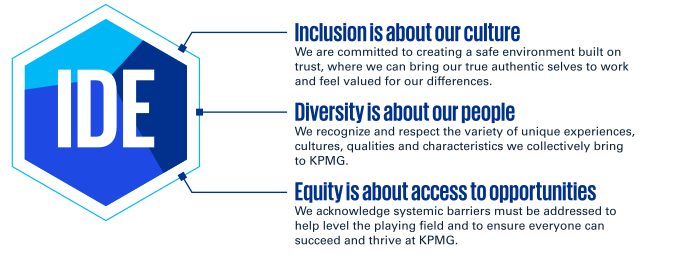
Our actions in support of this policy include removing systemic barriers in core processes, such as recruitment and promotion, to ensure equal career opportunities for all employees. We encourage inclusive sponsorship, particularly for women and non-native Dutch speakers, to address advancement gaps and promote leadership diversity. By implementing culture and training programs such as our IDE Impact Program for Partners and Directors and unconscious bias training, we build awareness of IDE issues, inclusive leadership, and communication skills.
KPMG supports ERGs and other employee communities, where individuals with shared backgrounds or identities can connect and support one another. We also foster cultural inclusion through initiatives including International Day, Culture Week, the Ramadan Challenge, and the option for people to exchange public holidays for culturally significant ones.
To amplify IDE in our workplace, we partner with external organizations, including Workplace Pride (participating annually in the Global Benchmark to evaluate and improve our LGBTIQ+ policies and practices) and the Agora Network (providing employees from culturally diverse backgrounds with access to masterclasses, mentoring, and networking opportunities). KPMG also takes part in Talent to the Top mentoring and coaching programs, which promote gender and cultural diversity in leadership and track progress through the Talent to the Top Monitor.
Metrics, targets, and performance
We report diversity metrics based on the headcount as of October 1 2025. To ensure our employees and equity partners feel seen and heard, we ask them to indicate whether they perceive themselves to be part of a vulnerable or marginalized group. This enables more targeted analysis of our GPS results and helps us formulate measures in response.
We report headcount for employees and non-employees as of the first reporting day of the next financial year, using October 1 as the reference date to reflect the year-end workforce situation, since assigned promotions take effect on that date.
|
Number of employees by gender (headcount) |
Number of employees (headcount) 2024/2025 |
Number of employees (headcount) 2023/2024 |
|
Male |
2,421 |
2,416 |
|
Female |
1,873 |
1,840 |
|
Other |
0 |
0 |
|
Not reported |
0 |
0 |
|
Total Employees |
4,294 |
4,256 |
Table 27
Our headcount in 2024/2025 increased by 0.9% compared to 2023/2024. There was a higher increase in the number of women (1.8%) relative to men (0.2%).
|
Number of employees (headcount) |
2024/2025 |
||||
|
Female |
Male |
Other |
Not reported |
Grand total |
|
|
Permanent |
1,568 |
2,102 |
0 |
0 |
3,670 |
|
Advisory |
534 |
824 |
0 |
0 |
1,358 |
|
Assurance |
770 |
1,073 |
0 |
0 |
1,843 |
|
Central Services |
264 |
205 |
0 |
0 |
469 |
|
Temporary |
305 |
319 |
0 |
0 |
624 |
|
Advisory |
107 |
145 |
0 |
0 |
252 |
|
Assurance |
138 |
139 |
0 |
0 |
277 |
|
Central Services |
60 |
35 |
0 |
0 |
95 |
|
Non-guaranteed |
0 |
0 |
0 |
0 |
0 |
|
Advisory |
0 |
0 |
0 |
0 |
0 |
|
Assurance |
0 |
0 |
0 |
0 |
0 |
|
Central Services |
0 |
0 |
0 |
0 |
0 |
|
Grand total |
1,873 |
2,421 |
0 |
0 |
4,294 |
|
Number of employees (headcount) |
2023/2024 |
||||
|
Female |
Male |
Other |
Not reported |
Grand total |
|
|
Permanent |
1,512 |
2,052 |
0 |
0 |
3,564 |
|
Advisory |
499 |
795 |
0 |
0 |
1,294 |
|
Assurance |
751 |
1,057 |
0 |
0 |
1,808 |
|
Central Services |
262 |
200 |
0 |
0 |
462 |
|
Temporary |
328 |
364 |
0 |
0 |
692 |
|
Advisory |
110 |
143 |
0 |
0 |
253 |
|
Assurance |
154 |
192 |
0 |
0 |
346 |
|
Central Services |
64 |
29 |
0 |
0 |
93 |
|
Non-guaranteed |
0 |
0 |
0 |
0 |
0 |
|
Advisory |
0 |
0 |
0 |
0 |
0 |
|
Assurance |
0 |
0 |
0 |
0 |
0 |
|
Central Services |
0 |
0 |
0 |
0 |
0 |
|
Grand total |
1,840 |
2,416 |
0 |
0 |
4,256 |
Table 28
The proportion of our employees with a temporary contract decreased in 2024/2025 to 14.5% from 16.3% in the previous year. The decline is primarily driven by fewer new joiners within Assurance following the Omnibus outcome and the fact that new joiners typically start on a one-year temporary contract. As a result, the overall ratio between permanent and temporary staff has shifted further toward permanent employment.
|
Gender diversity per employee category |
2024/2025 |
|||
|
Female |
Male |
|||
|
# |
% |
# |
% |
|
|
Partner/Director (incl. equity partners) |
113 |
23% |
385 |
77% |
|
Partner/Director (excl. equity partners) |
86 |
26% |
242 |
74% |
|
Senior Manager |
240 |
36% |
430 |
64% |
|
Manager |
306 |
43% |
400 |
57% |
|
Senior |
562 |
46% |
663 |
54% |
|
Junior |
482 |
42% |
671 |
58% |
|
Other |
197 |
93% |
15 |
7% |
|
Total employees |
1,873 |
44% |
2,421 |
56% |
|
Total employees and equity partners |
1,900 |
43% |
2,564 |
57% |
|
Gender diversity per employee category |
2023/2024 |
|||
|
Female |
Male |
|||
|
# |
% |
# |
% |
|
|
Partner/Director (incl. equity partners) |
105 |
22% |
377 |
78% |
|
Partner/Director (excl. equity partners) |
80 |
26% |
229 |
74% |
|
Senior Manager |
209 |
34% |
410 |
66% |
|
Manager |
280 |
41% |
396 |
59% |
|
Senior |
581 |
46% |
677 |
54% |
|
Junior |
495 |
42% |
687 |
58% |
|
Other |
195 |
92% |
17 |
8% |
|
Total employees |
1,840 |
43% |
2,416 |
57% |
|
Total employees and equity partners |
1,865 |
42% |
2,564 |
58% |
Table 29
Gender diversity across employee categories in 2024/2025 remained broadly consistent compared to 2023/2024. While overall representation did not change significantly, we continue to work toward increased female representation, particularly at senior career levels. For more information about our diversity targets see page 117.
|
Number of full- and part-time employees (headcount) |
2024/2025 |
||
|
Female |
Male |
Grand total |
|
|
Full-time |
1,391 |
2,221 |
3,612 |
|
Advisory |
488 |
889 |
1,377 |
|
Assurance |
740 |
1,132 |
1,872 |
|
Central Services |
163 |
200 |
363 |
|
Part-time |
482 |
200 |
682 |
|
Advisory |
153 |
80 |
233 |
|
Assurance |
168 |
80 |
248 |
|
Central Services |
161 |
40 |
201 |
|
Grand total |
1,873 |
2,421 |
4,294 |
|
Number of full- and part-time employees (headcount) |
2023/2024 |
||
|
Female |
Male |
Grand total |
|
|
Full-time |
1,359 |
2,208 |
3,567 |
|
Advisory |
453 |
861 |
1,314 |
|
Assurance |
745 |
1,160 |
1,905 |
|
Central Services |
161 |
187 |
348 |
|
Part-time |
481 |
208 |
689 |
|
Advisory |
156 |
77 |
233 |
|
Assurance |
160 |
89 |
249 |
|
Central Services |
165 |
42 |
207 |
|
Grand total |
1,840 |
2,416 |
4,256 |
Table 30
In 2024/2025, the proportion of employees working full-time was 83.7%, compared to 84% in 2023/2024. A higher proportion of women than men worked part-time (26.1% and 8.6% respectively). Within Advisory, we observed an increase in the number of women transitioning to full-time roles over the past year. This positive development contributes to the overall trend and reflects ongoing efforts to support and encourage female talent in pursuing full-time positions.
Table 31 compares this headcount-based information to the representative number in the financial statements, based on full-time equivalent (FTE), as an annual average and on October 1.
|
2024/2025 |
||||||||||
|
FTE – average |
FTE – October 1 |
Headcount – October 1 |
||||||||
|
(financial statements) |
(financial statements) |
(sustainability statement) |
||||||||
|
Female |
Male |
Grand total |
Female |
Male |
Grand total |
Female |
Male |
Grand total |
Of which equity partner |
|
|
Advisory |
610 |
994 |
1,604 |
627 |
1,016 |
1,643 |
651 |
1,028 |
1,679 |
71 |
|
Assurance |
904 |
1,300 |
2,204 |
892 |
1,275 |
2,167 |
924 |
1,291 |
2,215 |
92 |
|
Central Services |
301 |
239 |
540 |
298 |
244 |
542 |
327 |
250 |
577 |
7 |
|
Grand total |
1,815 |
2,533 |
4,348 |
1,817 |
2,535 |
4,352 |
1,902 |
2,569 |
4,471 |
170 |
|
2023/2024 |
||||||||||
|
FTE – average |
FTE – October 1 |
Headcount – October 1 |
||||||||
|
(financial statements) |
(financial statements) |
(sustainability statement) |
||||||||
|
Female |
Male |
Grand total |
Female |
Male |
Grand total |
Female |
Male |
Grand total |
Of which equity partner |
|
|
Advisory |
575 |
941 |
1,516 |
595 |
989 |
1,584 |
619 |
999 |
1,618 |
71 |
|
Assurance |
876 |
1,264 |
2,140 |
889 |
1,312 |
2,201 |
919 |
1,330 |
2,249 |
95 |
|
Central Services |
288 |
225 |
513 |
296 |
229 |
525 |
327 |
235 |
562 |
7 |
|
Grand total |
1,739 |
2,430 |
4,169 |
1,780 |
2,530 |
4,310 |
1,865 |
2,564 |
4,429 |
173 |
Table 31
In 2024/2025, overall workforce growth was primarily driven by Advisory, where headcount and FTE increased significantly to support the execution of the business plan, with a particular focus on end-to-end transformation initiatives. In Central Services, the reported average headcount was higher due to the inclusion of KPMG EMA General cost center allocations and the need for additional hires to facilitate ongoing transformation activities.
|
Total number of non-employees (headcount) |
2024/2025 |
2023/2024 |
|
Equity partners |
170 |
173 |
|
Offshore resources |
474 |
506 |
|
Contractors |
159 |
238 |
|
Interns |
75 |
117 |
|
Grand total |
878 |
1,034 |
Table 32
The total number of non-employees decreased by 15% in 2024/2025. This decline was primarily driven by the reduced use of independent contractors, mainly in Assurance, following the Omnibus announcement and the Employment Relationship Deregulation Act (Wet DBA). Lower hiring targets for consultants in Advisory also led to fewer intern starts. Additionally, a shift in external support from KGS India to KDN India contributed to the overall reduction. As a result, the proportion of non-employees relative to the total workforce declines compared to the previous year.
Target-setting is embedded in our annual business plan process. Based on prior-year results and future ambitions, the HR Leadership Team, led by the CHRO, proposes diversity targets that are subsequently discussed with and approved by the Board of Management. Our target-setting for increasing workforce diversity has primarily focused on enhancing gender diversity across various levels of KPMG, directly supporting our objective to provide equal opportunities to all our people.
We have established multiple targets for the Supervisory Board, the Board of Management, and the Partner/Director level (including equity partners). In addition, we have set a target for female representation within our Leadership Teams, which include the Group Leadership Team, the Board of Management, and the Leadership Teams of Assurance, Advisory, and Central Services. For the Supervisory Board and Board of Management, gender diversity targets are defined in the applicable governance regulations and formally determined by the Supervisory Board.
|
Gender diversity per leadership level |
Target for 2024/2025 |
Performance in 2024/2025 |
Performance in 2023/2024 |
||
|
% |
# |
% |
# |
% |
|
|
Female representation at Partner/Director level |
24% |
113 |
23% |
105 |
22% |
|
Supervisory Board |
6 |
5 |
|||
|
Female |
50% |
3 |
50% |
2 |
40% |
|
Male |
50% |
3 |
50% |
3 |
60% |
|
Board of Management |
4 |
4 |
|||
|
Female |
≥ 40% |
2 |
50% |
2 |
50% |
|
Male |
≥ 40% |
2 |
50% |
2 |
50% |
|
Leadership teams |
27 |
26 |
|||
|
Female |
30% |
12 |
44% |
12 |
46% |
|
Male |
15 |
56% |
14 |
54% |
|
Table 33
With 23% female representation at the Partner/Director level, we fell short of our target in 2024/2025. While we continue to succeed in our aim to hire and promote more women at Partner/Director level, and the percentage of women at the Partner/Director level has steadily increased over time, progress remains slow. This is due to the proportionally larger number of men in senior positions.
As part of our commitment to gender diversity, we aim to achieve 50% female representation on the Supervisory Board. Following the departure of Claartje Bulten in 2024, one position became vacant. On October 1, 2024, the Supervisory Board consisted of five members, 40% of whom were women. In June 2025, Barbara Frohn and Dirk Jan van den Berg were appointed as new members of the Supervisory Board (see section "Members of the Supervisory Board" in the management review). Dirk Jan van den Berg also succeeded Bernard Wientjes as Chair of the Supervisory Board. With these appointments, the Supervisory Board now consists of six members, three of whom are women, meeting our target of 50% female representation. With no changes in the membership of the Board of Management, its 50% gender balance remained at the end of 2024/2025.
Female representation in our Leadership Teams (comprising KPMG’s Group Leadership Team and the separate Leadership Teams of Assurance, Advisory, and Central Services) stands at 44% in 2024/2025, compared to 46% in the previous year. Although this represents a slight decrease, we continue to exceed our target of 30% and remain committed to promoting gender diversity at the leadership level.
|
Cultural diversity within business lines |
2023/2024¹ |
||
|
Dutch |
European migration origin |
Non-European migration origin |
|
|
Assurance |
51% |
10% |
39% |
|
Advisory |
65% |
12% |
24% |
|
Central Services |
62% |
8% |
30% |
|
Total |
58% |
10% |
32% |
|
Cultural diversity within business lines |
2022/2023 |
||
|
Dutch |
European migration origin |
Non-European migration origin |
|
|
Assurance |
54% |
10% |
36% |
|
Advisory |
66% |
12% |
22% |
|
Central Services |
64% |
7% |
29% |
|
Total |
60% |
10% |
30% |
Table 34
In 2024/2025, we obtained detailed insights into the cultural diversity of our employees and equity partners, using the Central Bureau of Statistics (CBS) Cultural Diversity Barometer to analyze data from 2023/2024.[1] The analyses show that 42% of our employees and equity partners are of non-Dutch origin, with the Assurance function showing the highest level of cultural diversity among our three business lines.
|
Cultural diversity per employee category |
2023/2024¹ |
||
|
Dutch |
European migration origin |
Non-European migration origin |
|
|
Partner/Director |
82% |
6% |
12% |
|
Senior manager |
65% |
8% |
27% |
|
Manager |
53% |
12% |
34% |
|
Senior |
51% |
12% |
37% |
|
Junior |
52% |
11% |
38% |
|
Other |
66% |
5% |
29% |
|
Total |
58% |
10% |
32% |
|
Cultural diversity per employee category |
2022/2023 |
||
|
Dutch |
European migration origin |
Non-European migration origin |
|
|
Partner/Director |
84% |
5% |
11% |
|
Senior manager |
66% |
10% |
23% |
|
Manager |
57% |
12% |
31% |
|
Senior |
53% |
12% |
35% |
|
Junior |
54% |
11% |
35% |
|
Other |
66% |
5% |
29% |
|
Total |
60% |
10% |
30% |
Table 35
Cultural diversity is highest among our junior and senior employee groups, and tends to decline at higher levels of seniority. In 2023/2024, 38% of juniors and 37% of seniors had a non-European migration origin, while this share is 12% at the Partner/Director level, a slight increase from 11% in the previous year. This reflects the trend we observe in our inflow: culturally diverse professionals, especially those from outside Europe, continue to increase, thereby strengthening diversity across all employee categories, including at the Partner/Director level. We are using the 2022/2023 data as a baseline for determining future targets and will continue our efforts to achieve the desired outcomes.
|
Employee distribution by age group (headcount/percentage) |
2024/2025 |
2023/2024 |
||
|
# |
% |
# |
% |
|
|
< 30 |
1,846 |
43% |
1,947 |
46% |
|
30–50 |
2,056 |
48% |
1,944 |
46% |
|
> 50 |
392 |
9% |
365 |
9% |
|
Total employees |
4,294 |
100% |
4,256 |
100% |
Table 36
In 2024/2025, the age distribution of our workforce remained broadly stable compared to 2023/2024, with 43% of employees under 30 years of age, 48% between 30 and 50, and 9% over 50. While the overall composition show little year-on-year change, the underlying dynamics reflect the impact of inflow, outflow, and aging within the existing employee base. The < 30 age group decreased by 2.7%, while the 30-50 and > 50 groups increased by 2.2% and 0.5%, respectively. This shift is primarily driven by employees aging to higher age brackets, combined with a relatively high inflow of < 30 employees and a higher outflow among older groups.
Gender equality and equal pay for work of equal value
Key policies and actions
|
Policy name |
Key contents |
|
Legal Framework Diversity Policy |
This policy guides our commitment to IDE, outlining the requirements necessary to achieve our IDE goals for our entire workforce. With gender equality and pay being central to KPMG's IDE programs, the policy also reinforces our dedication to positively impacting female employees by ensuring equal treatment for men and women in terms of pay, benefits, and advancement opportunities. |
As set out in our Legal Framework Diversity Policy (see section “Diversity within our own workforce”), gender equality and pay parity are central to KPMG’s IDE programs. The policy enforces equal treatment for men and women in terms of pay, benefits, and advancement opportunities.
We strive to ensure equal pay by annually monitoring our gender pay gap performance. In addition, our salary structure includes minimum and maximum salary ranges per function, helping to prevent unequal pay for work of equal value. To support gender-equal career progression and opportunities, we conduct an annual horizontal comparison of all promotions and performance outcomes across the organization at year-end. Covering all employees across Assurance, Advisory, and Central Services, this review helps us identify any biases or deviations and ensures gender-equitable performance outcomes.
Metrics, targets, and performance
Our target is to ensure equal pay for men and women within the same functions. To track our performance, we carry out process checks on the outcomes of promotions, performance reviews, and variable pay, actively monitoring the results. The findings from the gender pay gap assessment are reported to the Board of Management as part of our year-end review, which includes analysis of the promotion ratio, equal pay ratio, and progress on annual variable remuneration by gender. In 2024/2025, we found no significant differences in pay between employees performing comparable work, confirming compliance with equal pay principles.
|
Gender pay gap per employee category |
2024/2025 |
2023/2024 |
2022/2023¹ |
|
Partner/Director |
8.6% |
3.8% |
7.5% |
|
Senior manager |
6.6% |
5.5% |
6.2% |
|
Manager |
1.0% |
0.0% |
0.8% |
|
Senior |
3.1% |
2.3% |
2.0% |
|
Junior |
-1.4% |
-2.3% |
-0.6% |
|
Other |
4.7% |
4.2% |
-7.2% |
|
Grand total ² |
14.4% |
13.4% |
15.1% |
Table 37
The gender pay gap is reported in accordance with the ESRS requirements. The gender pay gap is defined as the difference between the average hourly pay for men and the average hourly pay for women, divided by the average hourly pay for men. This calculation includes all male and female employees within our organization, regardless of the nature of their work. As such, a pay gap may arise when there are proportionally more men than women in higher-level positions in the organization or within specific employee categories. The gender pay gap should not be confused with pay equality.
The gender pay gap highlights the importance of increasing female representation in senior roles. In 2024/2025, the overall gender pay gap increased to 14.4% from 13.4% in 2023/2024, largely due to developments at the Partner/Director level, where the gap widened to 8.6% (2023/2024: 3.8%). This change coincided with horizontal hires that added 6 women (+7.5%) and 13 men (+6.7%) in this category. At the senior manager level, the gap also increased by 0.8% to 3.1% (2023/2024: 2.3%). While the median total compensation for women remained stable (-0.1%), men’s median compensation increased by 5.8%, reinforcing the need for continued focus on pay equity and representation at senior levels.
The employee category “other” consists primarily of secretarial staff, with a smaller, diverse group of support staff within Assurance, Advisory, and Central Services. The number of men in this category is relatively low, and they hold a wide range of roles. As a result, the average hourly pay for men in this category tends to fluctuate from year to year.
Our internal annual analysis confirmed that, during the year under review, there was no significant gender pay gap among employees performing comparable jobs for the same duration. This outcome is consistent with our target of achieving equal pay for equal work. In addition, for all critical processes, such as bonus allocation, promotions, and YER, we apply a bias check aligned with a normal distribution to ensure fairness and objectivity. These measures reinforce that women within our organization receive equal pay, supporting our commitment to an equitable and inclusive reward structure. This metric is not validated externally.
|
Annual total remuneration ratio |
|
|
2024/2025 |
16.89 |
|
2023/2024 |
18.40 |
Table 38
The total annual remuneration ratio reflects the relationship between the highest remuneration within KPMG to the median total for our employees (excluding the highest paid individual). In 2024/2025, the ratio decreased to 16.89 from 18.40 in 2023/2024, indicating progress compared to the previous year while remaining broadly in line with historical levels.
As well as providing training to raise awareness of discrimination and unconscious biases, we equip development managers and community leaders with tools to lead inclusively and fairly. Our confidential counselors, Complaints and Disputes Committee, and whistleblowing hotline are available to our workforce who experience or witness discrimination (see section “Reporting and remediating negative impacts”).