|
Sustainability matter |
Key policies |
|
GHG emissions |
Environmental Handbook |
|
Travel Policy |
|
|
Procurement Policy |
|
|
Targets |
Key actions |
|
50% reduction in overall GHG emissions by 2029/2030 |
Installing smart building technology in our remodeled headquarters |
|
EcoVAdis Gold/CO₂-Prestatieladder level 5 by 2025/2026 |
Procuring certified green electricy for offices and EV charging |
|
98.5% reduction in Scope 1 emissions by 2029/2030 |
Introducing a new sustainable procurement policy |
|
100% reduction in Scope 2 market-based emissions by 2029/2030 |
Completing our ESG Dashboard |
|
26% reduction in Scope 3 emissions by 2030 |
Gaining better insights into supplier data |
Our impact and strategy
At KPMG, we aim to play our part in enabling a more environmentally sustainable future. This starts by reducing our operations’ negative contribution to climate change, which occurs primarily through our energy consumption in buildings, business travel, fuel use by our leased vehicle fleet, and purchased goods and services.
Our commitment to reducing greenhouse gas (GHG) emissions is outlined in the global KPMG Impact Plan, which forms the basis of our Dutch Impact Plan (described in the section “Value created through our Impact Plan” in the management review). We consider this plan our strategy for climate change mitigation, as described below. Decarbonization is critical to limiting the harmful effects of climate change. While we recognize the complexity of this journey, particularly in addressing Scope 3 emissions, we remain focused on quantifying and mitigating the impact of our operations and services. Our approach includes aligning with KPMG International’s science-based targets (SBTs), integrating climate considerations into our decision-making, and helping our clients navigate their own climate-related challenges.
Our DMA reevaluation concluded that GHG emissions continue to be material for KPMG. This section provides an overview of our current impact in this area. It includes forward-looking statements aligned with the ESRS E1 guidelines, outlines our strategy for emission reductions, and encompasses the KPMG Impact Plan, including our related policies, actions, targets, and metrics.
|
E1 Climate change |
Impact materiality |
Financial materiality |
Value chain |
||
|
Sustainability matter |
Positive |
Negative |
Opportunity |
Risk |
|
|
GHG emissions (Scopes 1, 2 and 3) |

|

|
|||

|
|||||
Responsibility for climate action, including the implementation and monitoring of climate-related policies, targets, and actions, lies with our Chief Operating Officer (COO), on behalf of the Board of Management. The Corporate Responsibility team, in collaboration with departments such as Facilities and Procurement, leads the development and execution of these plans. We communicate our climate-related strategies and policies through multiple channels, including our intranet, integrated report, and Impact Plan. Our Impact Plan is reviewed annually and incorporated into our yearly business and financial planning. Progress is measured and reported to our Board of Management every quarter and discussed by the Central Services Leadership Team every six weeks.
We monitor progress toward policy objectives, targets, and action plans through internal control systems and dashboards. We are actively working to improve data collection and quality through automation, enabling more effective monitoring and informed strategic decision-making.
Stakeholders are actively involved in target-setting. This engagement takes place through our annual GPS, consultations with the Young Board Now, and collaboration with subject-matter experts and department leads within representative bodies such as the Central Services Leadership Team, led by our COO.
Strategy for climate change mitigation
The Planet pillar of our Dutch Impact Plan outlines KPMG’s commitments and objectives related to climate change. We are not excluded from the European Union (EU) Paris-Aligned Benchmarks and are actively engaged in reducing our carbon emissions.
KPMG adheres to KPMG International's commitment to achieving a near-term SBT of reducing GHG emissions by 50% across Scopes 1, 2, and 3 by 2029/2030, relative to a 2018/2019 baseline. This target is aligned with the Paris Agreement goal of limiting global warming to 1.5°C and was validated by the Science Based Targets initiative (SBTi) in 2021. KPMG adopted this target and translated it into scope-specific objectives based on our baseline data. KPMG International formally revalidated this target in 2025.
In 2024/2025, based on KPMG International’s SBTi-validated targets, and KPMG International’s Climate Transition Plan, we started preparing our own Transition Plan. This plan will support more structured and measurable progress toward our emission reduction goals. While we initially intended to complete this work during this fiscal year, we have chosen to align our approach with that of KPMG International. As a result, we will finalize the plan in 2025/2026, incorporating best practices and insights from across our KPMG International network to ensure a robust and future-proof strategy.
Four decarbonization levers
To reduce our carbon footprint effectively and meet our 2029/2030 reduction target of 50%, we have identified four major sources of GHG emissions that we aim to reduce. Our key actions related to these “decarbonization levers” are described in Our Impact Plan. These actions are not expected to result in changes to our service portfolio or the technologies used in our operations.
The main decarbonization levers in our journey to net zero
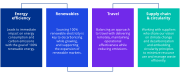
Although the four decarbonization levers are identified and qualitatively described above, it is currently not possible to estimate the quantitative contribution of each individual lever to achieving our reduction targets. We aim to further quantify these contributions in future reports as additional data becomes available and our Transition Plan is finalized.
Improving emissions data processing
As part of our ongoing sustainability initiatives, we are implementing a structured automation process to collect primary data on Scope 1, 2, and 3 GHG emissions. This data feeds into our ESG Dashboard, which enhances the accuracy, consistency, and timeliness of our emissions reporting.
By the end of the reporting year, we had made progress in tracking office energy consumption (both natural gas and electricity), including by implementing a day-to-day monitoring mechanism across most KPMG offices. This granular data enables better monitoring and steering of our decarbonization strategy. The insights gained can be used to identify trends, optimize use patterns, and inform future sustainability decisions.
Refining our Scope 3 emissions accounting through improved data accuracy has remained a key focus area this year. While accurate primary data was available for business travel, employee commuting, and IT hardware suppliers in the previous reporting year, our current efforts are focused on improving the quality and granularity of secondary data. We are also working to expand the use of supplier specific and activity-based data for a broader range of purchased goods and services. At present, other purchases than IT hardware are still accounted for using a spend-based methodology, which we are actively refining to improve its reliability.
Climate scenario modeling and risk assessment
KPMG International has conducted a climate risk assessment with quantitative scenario modeling using 1.5°C- and 4°C-scenario pathways, representing a Paris‑aligned trajectory and a business-as-usual baseline, respectively. However, none of the physical risks identified are considered material for our firm.
Furthermore, in 2024/2025, KPMG International initiated a climate risk assessment project in collaboration with member firms, including our active participation. This project involves quantitative scenario analysis aligned with the requirements of the CSRD, with the final outcomes expected to be completed by the end of 2025/2026.
Our primary transition risks and opportunities stem from the anticipated shifts in sector growth and contraction across the industries served by KPMG member firms. Given our multidisciplinary model and diverse geographic and sector exposure, we consider these transition risks unlikely to materially affect our business model or overall revenue goals. Our primary opportunities stem from our role in supporting our clients with their transition; this is explained in more detail in the “Consumers and end-users” chapter.
Key policies and actions
|
Policy name |
Key contents |
|
Environmental Handbook |
This contains KPMG’s environmental policy plan and describes our Environmental Management System, governance structure, and audit process. It sets environmental objectives until 2030 and tracks interim progress. |
|
Travel Policy |
This policy mandates rail or car travel for journeys under 700 km or eight hours. Business class bookings are only permitted for flights longer than six hours. |
|
Procurement Policy |
In 2025/2026, our Procurement Policy will incorporate the target of 26% emissions reduction for purchased goods and services, which will apply through 2029/2030. |
With emission reduction targets in place (see section “Metrics, targets, and performance”), we have implemented policies and action plans to achieve them. Our three key policies are aligned to the decarbonization levers described above. These policies apply across our three business lines – Assurance, Advisory, and Central Services – and were developed through engagement with key stakeholders.
Each policy defines the critical actions we are taking to meet our targets. In 2024/2025, we updated both the Environmental Handbook and our Supplier Code of Conduct, to include more concrete actions and a clearer reduction pathway to meet our 2029/2030 targets.
In executing the Environmental Handbook, we use our Environmental Management System as a framework. Updated on a rolling basis, it translates our environmental approach into concrete actions and key performance indicators (KPIs), ensuring that our ambitions are operationalized and monitored effectively. As well as supporting the implementation of actions from the handbook, it enables preventive and corrective measures where needed. This provides structured insights into our environmental impact and how we aim to reduce it. The handbook and management system also respond to stakeholder requests for more concrete evidence of our environmental commitments. KPMG's ISO 14001 certification and the CO2 Performance Ladder certification serve as a foundation for continuous improvement in how we measure and manage our climate targets.
During the year, we took action to mitigate climate change across our four decarbonization levers, as described on the next page. These actions are embedded in our annual business cycle and are revisited every year. The resources allocated to these actions are primarily OpEx, related to sustainable procurement and facility decisions. These costs are not considered significant, as they are integrated into our regular operating budgets and do not require material capital expenditure (CapEx). As such, no significant investments are needed to implement our climate-related initiatives.
Lever 1: Energy efficiency
Beyond renewable energy use, our environmental policy also prioritizes energy efficiency in our buildings. During the ongoing remodeling of our Amstelveen headquarters, we are implementing smart building technologies, including occupancy sensors, to reduce our annual energy consumption. These initiatives are aligned with our commitment to continuous improvement and are supported by the ESG Dashboard, which enhances our ability to track emissions and energy use in real time.
Lever 2: Renewable energy
Our renewable energy actions focus primarily on electricity consumption in our buildings and by our Electric Vehicle (EV) fleet, including purchasing Energy Attributes Certificates (EACs). As part of our broader decarbonization strategy, we also acquired Dutch-certified EACs in 2024/2025 to green the electricity used to charge our EV fleet. This complements our commitment to phasing out fossil-powered lease cars by 2029/2030. To support our renewable energy goals, we have tightened the requirements for office building owners during contract renewals and are now mandating the use of sustainably sourced energy and higher energy-label standards.
Lever 3: Sustainable mobility
After purchased goods and services, business travel – especially air travel – is our second-largest source of emissions, accounting for approximately 15% of KPMG’s total footprint.
Our Impact Plan and Travel Policy outline actions to reduce emissions from mobility and promote sustainable travel practices. These include mandatory rail or car travel for journeys under 700 km, rules on business class bookings, and the promotion of video conferencing as the default for meetings. In 2024/2025, we also launched an internal awareness campaign to communicate our emission targets and the impacts of different travel behaviors, encouraging more sustainable decision-making around business travel.
For business travel by car, our sustainable mobility approach includes phasing out fossil-powered lease cars. As of 2024/2025, only electric lease cars are offered, and we expect our entire lease fleet will be electric by 2027/2028, two years ahead of our target.
Reducing air travel remains a challenge due to the growing demand from clients for in-person meetings. To stimulate reductions in air travel emissions, KPMG uses an Internal Carbon Pricing (ICP) mechanism. In 2024/2025, we began implementing ICP as a “shadow price,” meaning that while emissions from flights are tracked and priced internally, the cost is not yet reflected in profit-and-loss statements. The application of the “polluter pays” principle has been approved for implementation in 2025/2026. When flying is necessary, we encourage our people to book economy class or premium economy over business class, which can reduce emissions by 30%-60% per trip.
Lever 4: Sustainable supply chain and circularity
We recognize that ongoing and proactive engagement with our suppliers is critical to achieving our decarbonization ambitions. Purchased goods and services represent a significant portion of our Scope 3 emissions and are a key focus in our emission-reduction plan.
In 2024/2025, we launched a Procurement Framework to accelerate sustainability improvements in Scope 3. ESG criteria are now embedded in all large project requests for proposal (RFPs), influencing decisions involving more than EUR 45 million in spend (55% of our total). We introduced a supplier segmentation model to assess the level of ESG impact and a supplier engagement framework to guide procurement teams in meaningful interactions. Our new Supplier Code of Conduct, containing clear sustainability requirements, has been signed by approximately 71% of suppliers in new contracts.
We also developed a category-specific approach to ESG contract clauses and provided procurement staff with targeted training on sustainability fundamentals and how to use the new clauses.
To further drive change, we created an early engagement loop between Procurement and Corporate Responsibility, increasing awareness of upcoming large projects. The aim is to drive behavioral change and embed a sustainability mindset in everything we do.
Metrics, targets, and performance
Our GHG emissions are reported for the financial year running from October 1, 2024, to September 30, 2025. They are calculated according to the calculation methodology of the GHG Protocol and aligned with the ESRS guidelines on emissions reporting. Emissions cover the entire KPMG organization, including our Assurance, Advisory, and Central Services business lines.[1]
We use 2018/2019, the last full financial year before the COVID-19 pandemic, as our baseline year, as it represents a realistic and stable starting point. This baseline is representative in terms of the activities covered and the influences from external factors. The 2018/2019 year reflects our normal business operations prior to the significant disruptions caused by the pandemic, ensuring comparability and reliability of our emissions data over time. These baseline values are reported in Table 5.
KPMG has a near-term SBT of 50% gross decarbonization across all scopes by 2029/2030, compared to our 2018/2019 baseline. Our COO approved this target on behalf of the Board of Management. We are currently developing our Transition Plan as part of our commitment to long-term climate action in alignment with KPMG International. This strategic alignment allows us to incorporate best practices and insights from across our global network. As a result, we will finalize the plan in 2025/2026, ensuring it provides a solid foundation for structured, measurable, and long-term-oriented progress. In addition, KPMG International is assessing the feasibility of a long-term decarbonization target for 2049/2050 as part of its net-zero ambition.
In 2024/2025, we introduced year-on-year targets within our Environmental Management System for the first time. These apply to Scope 1 and 2 emissions as well as to Scope 3 emissions related to business travel. Our current focus is on improving the related data, which will further inform our Scope 3 strategy. Compared to last year, we transitioned from static spreadsheet-based reporting to a newly developed ESG Dashboard that enables more dynamic, partially automated tracking of emissions data across internal and external sources. Tables 3 and 4 show the Scope 1 and 2 emission streams and Scope 3 emission categories that are material for our reporting (see the appendices to the sustainability statement for details of the non-applicable categories).
|
Scope |
Category |
Primary source for KPMG N.V. |
|
Scope 11 |
Stationary combustion |
Natural gas used at our rented KPMG N.V. offices in the Netherlands |
|
Mobile combustion |
Fuels used by our leased cars |
|
|
Scope 2 |
Location-based² |
Energy used at our rented KPMG offices in the Netherlands and by our leased electric cars |
|
Market-based³ |
||
|
Vehicle related |
Table 3
|
Scope |
Category |
Primary source for KPMG N.V. |
Calculation methodology |
Value chain relevance |
|
Scope 3 |
Category 1 – Purchased goods and services |
Goods and services purchased through the Procurement department |
Spend-based method |
Upstream |
|
Product carbon footprint analysis for our IT devices; spend data analysis for all other categories |
Average data method |
|||
|
Category 3 – Fuel and energy-related activities |
Upstream emissions (before combustion) of the fuel consumed in Scope 1 and 2 |
Average data method |
Upstream |
|
|
Category 5 – Waste generated in operations |
Waste generated in our rented KPMG offices in the Netherlands |
Supplier specific method |
Own operations |
|
|
Category 6 – Business travel |
Business-related travel made by KPMG employees by air, rail, or road |
Average data method |
Own operations |
|
|
Category 7 – Employee commuting |
Travel undertaken by employees between their homes and KPMG offices |
Average data method |
Own operations |
Table 4
All emission-reduction targets are reported as absolute values, expressed as a percentage of base-year emissions. Targets per emission scope are detailed in Table 5. All targets are gross, as we do not engage in any GHG removals or carbon-credit trading, nor do we contribute to avoided emissions.
Table 5 presents our emission-reduction performance per emission stream/category in 2024/2025, compared to the previous year and our baseline year.
|
Gross Scope 1,2 and 3 emissions (tCO₂e) |
Retrospective |
Milestones and target year |
||||
|
Emission category |
Base year 2018/2019 |
2024/2025 |
2023/2024 |
2023/2024 vs 2024/2025 |
Baseline 2019/2020 vs 2024/2025 |
Target year |
|
Scope 1 GHG emissions |
||||||
|
Gross Scope 1 GHG emissions (tCO2e) |
8,532 |
1,333 |
2,110 |
-37% |
-84% |
-98.5% |
|
Scope 2 GHG emissions |
||||||
|
Gross location-based Scope 2 GHG emissions (tCO2e) |
1,888 |
3,827 |
3,071 |
25% |
103% |
N/A |
|
Gross market-based Scope 2 GHG emissions (tCO2e) |
2,282 |
0 |
2,884 |
-100% |
-100% |
100% |
|
Scope 3 GHG emissions |
||||||
|
Total gross indirect (Scope 3) GHG emissions (tCO2e) |
22,990 |
28,885 |
29,431 |
-2% |
26% |
-26%¹ |
|
Category 1. Purchased goods and services |
14,318 |
22,069 |
21,345 |
3% |
54% |
|
|
End-user IT devices |
161 |
824 |
1,325 |
-38% |
412% |
N/A |
|
Other commodities and services |
14,157 |
21,245 |
20,020 |
6% |
50% |
|
|
Category 3. Fuel and energy-related activities (not included in Scope 1 or Scope 2) |
2,357 |
1,220 |
1,688 |
-28% |
-48% |
N/A |
|
Category 5. Waste generated in operations |
4 |
3 |
3 |
0% |
-25% |
|
|
Category 6. Business travel² |
6,228 |
4,253 |
6,191 |
-31% |
-32% |
N/A |
|
Category 7. Employee commuting² |
203 |
1,340 |
204 |
557% |
560% |
N/A |
|
Total GHG emissions (location-based) (tCO2e) |
33,410 |
34,045 |
34,613 |
-2% |
2% |
N/A |
|
Total GHG emissions (market-based) (tCO2e) |
34,351 |
30,218 |
34,426 |
-12% |
-12% |
-50% |
Table 5
The SBTi target requires a 4.2% reduction in gross Scope 1, 2, and 3 emissions every year between 2018/2019 and 2029/2030. We did not meet this target in 2024/2025, recording instead a 2% market-based decrease compared to 2023/2024. This highlights the challenges of decarbonization and the need for further concrete action in the years ahead.
|
GHG intensity per net revenue |
2024/2025 |
% (2024/2025)/(2023/2024) |
2023/2024 |
|
Total GHG emissions (location-based) per net revenue (tCO2eq/EUR 1,000) |
0.0420 |
94% |
0.0449 |
|
Total GHG emissions (market-based) per net revenue (tCO2eq/EUR 1,000) |
0.0373 |
83% |
0.0447 |
Table 6
Based on net revenue of EUR 810 million, our GHG intensity data confirm that our measures remain effective despite continued business growth. In 2024/2025, we achieved a reduction in emission intensity compared to the previous year. While Scope 2 location-based emissions decreased to 94%, Scope 2 market-based emissions decreased to 83%, demonstrating that our transition to renewable energy and electrification continues to deliver substantial progress toward our decarbonization targets.
Scope 1 and 2 performance
By the end of 2024/2025, compared to our 2018/2019 baseline, we had reduced Scope 1 emissions by approximately 84% (from 8,532 tCO₂e to 1,333 tCO₂e) and Scope 2 market-based emissions by 100% (from 2,828 tCO₂e to 0 tCO₂e). This amounts to a 90% decrease in Scope 1 and 2 emissions compared to our 2018/2019 baseline.
This significant progress is primarily driven by the phase-out of fossil-fueled lease cars, with 88% of our fleet now electric compared to just 9% in 2018/2019. The transition to electric vehicles has led to a 59% increase in electricity consumption compared to last year, mainly due to EV charging, which raised Scope 2 location-based emissions. However, this impact was fully offset by sourcing 100% renewable electricity for both our offices and vehicle fleet through EACs, resulting in zero Scope 2 market-based emissions.
Additional measures, such as implementing smart building technologies during the remodeling of our Amstelveen office and purchasing EACs, have further supported our decarbonization efforts. We have already achieved our strategic target of 100% renewable energy use well ahead of the 2029/2030 deadline. In 2024/2025, renewable electricity use in our offices reached 100%, up from 97.2% in the previous year, underscoring our commitment to certified green energy sourcing and compliance with ESRS requirements.
Scope 3 performance
Business growth in recent years has resulted in higher Scope 3 emissions, primarily attributable to higher spending on purchased goods and services. Since these emissions are calculated using a spend-base approach, they rise in line with spending. Additionally, we refined the allocation of emissions by refining the spend-based data distribution, ensuring a more accurate representation of emissions across expenditure categories. Despite this increase in purchased goods and services, overall scope 3 emissions have slightly decreased (1.9%) from 29,431 tCO2e in 2023/2024 to 28,885 in 2024/2025 due to reductions in other categories and methodological improvements.
For business travel, emissions are mainly driven by air travel. Air travel emissions decreased from 5,419 tCO2e in 2018/2019 to 4,053 tCO2e in 2024/2025 representing a reduction of 25.2%. This reduction is due to improved data quality and tracking, which resulted in an allocation of emissions from business travel to commuting and provided a more accurate representation, as well as updated emission factors that lowered emissions per flight. This reclassification reflects more accurate reporting and contributes to the overall decline in business travel emissions. Air travel in particular showed a decrease compared to the base year, largely due to the June 2025 update of emission factors set by the UK Department for Energy Security and Net Zero. In addition, there has been a shift toward lower service classes, such as economy and premium economy, which can reduce emissions per trip by approximately 30%–60%.
Our target is to reduce our Scope 3 emissions by 26% by 2029/2030 compared with 2018/2019, equivalent to just over 2% per year. While the updated emission factors have mitigated what would have been a sharper increase under previous factors, overall emissions are still rising rather than declining. We are therefore not yet on track. However, we expect the development of our Transition Plan and the implementation of targeted policy updates to accelerate progress. These actions lay the foundation for achieving our 2029/2030 target.
EcoVadis Gold Medal
We met our target of achieving an EcoVadis Gold Medal in 2024/2025, an improvement on last year's Silver. EcoVadis is a globally recognized platform that assesses companies on their management of environmental, social, and ethical criteria, with Gold awarded to organizations that rank in the top 5% of all companies assessed worldwide. This demonstrates our progress in integrating sustainability into our operations and confirms our position as a reliable partner for clients with high ESG standards.
Validation of GHG emissions metrics
Gross Scope 1, 2, and 3 GHG emissions, as well as total GHG emissions, are measured in accordance with the GHG Protocol. These metrics are validated by an external party that is independent of the assurance provider of our sustainability statement; namely, DEKA, a CO₂-Prestatie Ladder-certified organization. At level 3 (our current certification level), DEKA’s audit includes Scope 1 and Scope 2 emissions, as well as business travel emissions. Starting from December 2025, emissions from purchased goods and services will also be included. DEKA’s validation is separate from the limited assurance provided by PwC, which also includes Scope 3 emissions as part of its assurance scope.