Our system of governance is based on checks and balances, ensuring sound decision-making. We have a formal two-tier governance structure comprising a Board of Management and a Supervisory Board. This structure is supported by internal policies and controls and by our Code of Conduct, which sets out our values and commitment to responsible business.
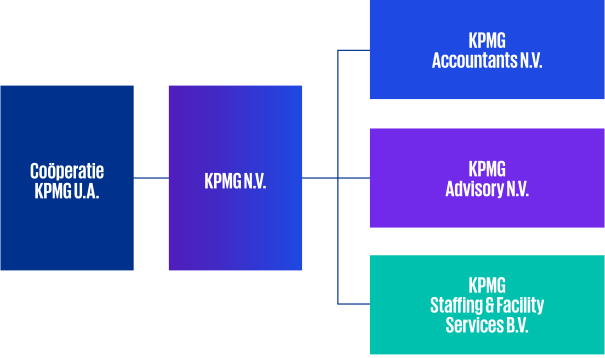
KPMG N.V. is a holding company for our Assurance, Advisory, and Central Services activities. The contents of this chapter therefore relate to KPMG N.V. but also apply to KPMG Accountants N.V. (“Assurance”), KPMG Advisory N.V. (“Advisory”), and KPMG Staffing & Facility Services B.V. (“Central Services”). KPMG Accountants N.V. is a 100% subsidiary of KPMG N.V.[1]
All shares in KPMG N.V. are held by Coöperatie KPMG U.A. Our equity partners are members of this cooperative through their individual practice companies. These partners provide services to KPMG N.V. clients under a management agreement with the cooperative. Under Dutch law, Coöperatie KPMG U.A. board members are considered co-policymakers.
External regulation
The Authority for the Financial Markets (AFM) is responsible for overseeing audit firms in the Netherlands. This oversight is based on, among other mechanisms, two Dutch acts:
Audit Firms Supervision Act (Wet toezicht accountantsorganisaties; Wta)
Auditors’ Profession Act (Wet op het accountantsberoep; Wab)
To operate, all audit firms must have a license from the AFM. KPMG aims to maintain active, two-way communication with the AFM, which conducts regular inspections of KPMG Accountants N.V. The US Public Company Accounting Oversight Board (PCAOB) and the Royal Netherlands Institute of Chartered Accountants (Koninklijke Nederlandse Beroepsorganisatie van Accountants; NBA) also carry out regular inspections. See Operating environment for more information on recent inspections.
In the Netherlands, audit clients classified as public-interest entities (PIEs) according to Dutch law must change their audit firm at least once every 10 years and their external auditor at least once every five years. In addition, there is a four-year cooling-off period before a former audit firm may be re-hired.
Although KPMG N.V. is not legally required to apply the Dutch Corporate Governance Code (“the Code”), we voluntarily apply its principles as and where relevant.
At an international level, KPMG regularly discusses industry matters with the International Forum of Independent Audit Regulators (IFIAR) and representatives from the Committee of European Auditing Oversight Bodies (CEAOB).
Role of the Board of Management and Supervisory Board
We have a two-tier management structure:
Our Board of Management manages the firm and is responsible for strategy, performance, and value creation.
Our Supervisory Board oversees the work of the Board of Management, operating in part through three committees: Assurance Quality, Audit & Risk, and Remuneration & Appointment.
The Board of Management comprises four members: the Chief Executive Officer (CEO), the Chief Operating Officer (COO), and the heads of our Assurance and Advisory businesses. Members are appointed by the Supervisory Board, following approval by KPMG N.V.’s shareholder, Coöperatie KPMG U.A.
The Supervisory Board comprises six members, all of whom are external and independent of the firm’s management. All Supervisory Board members are appointed by KPMG N.V.’s shareholder, Coöperatie KPMG U.A., upon nomination by the Supervisory Board for terms of up to four years. Members may serve no more than two terms, for a maximum of eight consecutive years. Supervisory Board members are also considered co-policymakers under the Wta. For more information, see the Supervisory Board report.
We aim for diversity among the members of both the Board of Management and the Supervisory Board, as we believe this leads to better long-term decision-making. Diversity is built into the rules of procedure and profile descriptions for both boards. Our aim is for women to make up 50% of our Supervisory Board and for each gender to make up at least 40% of our Board of Management. See the Social chapter of our sustainability statement for more information.
Our Board of Management and Supervisory Board rules can be found on the KPMG website.