For our 2024/2025 sustainability statement, we used the outcome of the 2023/2024 DMA as a starting point. This decision was primarily driven by the fact that the previous DMA was finalized relatively late in the reporting cycle, and there was no need for a full, bottom-up reassessment. Instead, we opted for a targeted review of the existing analysis, while maintaining compliance with ESRS requirements. We followed the same four steps as used in our original DMA.
We will continue to reassess our sustainability matters on an annual basis, taking into account any regulatory developments, such as the Omnibus package amending the first set of ESRS, that could affect our future reporting obligations.
Double materiality assessment: Four-step process
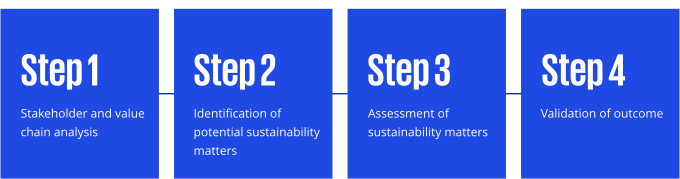
Step 1: Stakeholder and value chain analysis
We reconfirmed the relevance of our stakeholder groups and value chain, focusing on our core activities in Assurance and Advisory. At the request of the Audit & Risk Committee (ARC), we placed additional emphasis on external stakeholders. In light of the Omnibus package, this analysis was focused on developments at regulatory bodies such as the AFM, the US Public Company Accounting Oversight Board (PCAOB), and NBA. We used sources including the AFM’s "Trendzicht" report and the 2025 AFM agenda to inform this step.
Step 2: Identification of potential sustainability matters
Taking the 2023/2024 DMA as a starting point, we did not identify any new potential sustainability matters relevant for 2024/2025. There were also no changes to our organization or environment that warranted updates to this step.
Step 3: Assessment of sustainability matters
In February 2025, the results of the 2023/2024 DMA, together with the mentioned reports, were discussed within the IR project team. The material topics established in 2023/2024 were critically reevaluated, taking into account the impact of socioeconomic, geopolitical, and societal developments. We also considered whether topics from the longlist should be included in the shortlist, and whether new topics should be added based on current insights.
This process resulted in one change: the sustainability topic "Adequate wages" has been removed as a material topic. When the topic was first identified, labor market pressure and wage adequacy were considered significant risks for KPMG. However, recent developments show that these pressures have eased considerably, reducing the relevance and potential impact of this issue on our business and stakeholders. Based on this reassessment, the topic no longer meets the threshold for materiality.
IROs were also reevaluated, with only minor changes to wording in some cases. During the process, due to questions from the ARC and differences in market practice, two topics were discussed in more detail: “Workers in the value chain” and “The disruptive nature of AI.” After extensive discussion, both topics were classified as not material.
Step 4: Validation of outcome
In April, these conclusions were discussed with the Board of Management and the ARC. The Board and ARC reconfirmed the material topics and no changes were made. The sustainability matters identified (see Table 2) are primarily relevant in the short to medium term and are already embedded in our strategy and operations.
Concluding whether a given matter constituted an impact, a risk, or an opportunity was challenging, particularly in the social domain. We found that nearly all our sustainability matters contain elements of impact as well as financial risks or opportunities. We recognize that, in general, mitigating negative impacts can help reduce exposure to financial risks, and that effectively addressing such impacts may also lead to financial opportunities. However, in line with ESRS guidance, our materiality assessment is based on the inherent characteristics of impacts, risks, and opportunities prior to considering any mitigating actions.
Where sustainability matters were deemed to have a material impact, we assessed both the current and anticipated financial effects of its material risks and opportunities on our financial position, performance, and cash flows, noting that we do not always have a complete view of these effects. We anticipate that future stakeholder feedback, peer insights, regulatory developments, and further changes to the ESRS standards may influence the outcome of our DMA in the years ahead.
Disclosures on sustainability matters
As the outcome of our DMA determines the reporting scope and disclosure requirements of KPMG’s sustainability statement, we have included a detailed “Reference table.” This index lists all the ESRS disclosure requirements that we have complied with, along with the corresponding paragraphs where the related disclosures can be found, to ensure clarity and transparency in our reporting.
We determined the material information to be disclosed in our sustainability statement by applying the criteria outlined in ESRS 1 section 3.2. Specifically, we applied paragraph 31 of ESRS 1 in assessing the significance of information and whether it would influence the decision-making needs of users of the sustainability statement.
In addition to ESRS-related sustainability matters, we also report on five entity-specific sustainability matters: Mental health and safety, Employee attraction and retention, (Audit) Quality focus (including AQIs), Impact on sustainability performance in society through our Assurance and Advisory services, and Data security. While not explicitly covered by the ESRS, these are part of our license to operate and critical to our long-term sustainability performance.
After a thorough review of our assets, office locations, and business activities, including desktop research and interviews with internal stakeholders and subject-matter experts, we did not identify any material IROs associated with pollution, water or marine resources, biodiversity, circular economy, or ecosystems. As a result, we do not address the related ESRS requirements in our sustainability statement: Pollution (ESRS E2), Water and Marine Resources (ESRS E3), Biodiversity and Ecosystems (ESRS E4), Resource Use and Circular Economy (ESRS E5), Workers in the Value Chain (ESRS S2), and Affected Communities (ESRS S3).
In the Environmental, Social, and Governance chapters of our sustainability statement, we address the relevant material sustainability matters by grouping them into broader “material themes.”
Results of our DMA review
The results of our DMA review process, described above, are set out in Table 2, which maps our material IROs to the relevant ESRS topical standards.
|
Sustainability matter |
Type of IRO |
IRO description |
Value chain |
Time horizon |
|||||
|
Impact materiality |
Financial materiality |
||||||||
|
Positive |
Negative |
Actual / potential |
Oppty |
Risk |
|||||

|
E1 Climate change |
||||||||
|
Our impact on climate |
|||||||||
|
GHG emissions |

|
Actual |
Although we are not heavily involved in high-emission-intensity activities, we acknowledge the negative impact of Scope 1, 2, and 3 GHG emissions – primarily driven by business travel and purchased goods and services, as well as the environmental effects of our buildings and fleet. |

|
ST, MT, LT |
||||

|
S1 Own workforce related to working conditions |
||||||||
|
Working conditions |
|||||||||
|
Employee attraction and retention |
Not applicable |
|
Attracting and retaining employees, as well as developing top talent, offers significant opportunities for our present and future success. It supports our employees to deliver high-quality services to our clients, boosts productivity and innovation, and ultimately leads to long-term financial benefits for our firm. |

|
ST, MT |
||||
|
Training and skills development for our own workforce |
|
Actual |
Training and education for our own workforce includes the education programs and resources through which our people can improve their knowledge, abilities, and job performance. This can positively impact individuals by increasing their job satisfaction, earning potential, and employability. impact individuals by increasing their job satisfaction, earning potential, and employability. |
|
ST, MT |
||||
|
Well-being and engagement |
|||||||||
|
Social dialogue within our own workforce |
Not applicable |
|
Ensuring effective social dialogue with our own workforce on topics such as employee well-being can lead to increased productivity, better working conditions, and increased turnover. This is a material opportunity for us, given our strong focus on employee engagement (i.e., the communication and cooperation between employers and employees). |
|
ST, MT |
||||
|
Work-life balance for our own workforce |
|
Actual |
In our high-performance working environment, long working hours, lack of flexibility, or insufficient recovery time can disrupt people’s work-life balance and lead to structural impacts on employees, such as increased absenteeism, reduced engagement, and higher staff turnover. These effects can negatively impact both individual well-being and the organization’s long-term performance. |
|
ST, MT |
||||
|
Mental health and safety for our own workforce |
|
Actual |
Our people operate in a high-performance and dynamic working environment, which, if not properly managed, can lead to psychological strain. Prolonged exposure to pressure may result in stress, anxiety, and even burnout. These mental health challenges can negatively impact employees’ ability to function effectively, reduce productivity, and lead to extended periods of absence. |
|
ST, MT |
||||
|
Non-discrimination within our own workforce |
|
Actual |
We are committed to reducing all forms of discrimination within our own workforce. We acknowledge that discrimination can contribute to negative impacts for our workforce and we endeavor to ensure fair treatment and opportunities for all our people, regardless of their gender, race, age, or other characteristics. |
|
ST, MT |
||||
|
Privacy for our own workforce |
|
Actual |
Privacy is about protecting the personal information and individual rights of our people, including their personal data, online activities, and physical movements. We attach great importance to preventing negative impacts that occur when privacy is not sufficiently protected. |
|
ST, MT |
||||
|
Inclusion, diversity, and equity (IDE) |
|||||||||
|
Diversity within our own workforce |
|
Actual |
An environment that does not foster IDE can cause negative impacts for our employees. IDE forms an important pillar within our business. We strive to create a psychologically safe environment that is diverse and inclusive, providing equal access to opportunities for all our employees. |
|
ST, MT |
||||
|
Gender equality and equal pay for work of equal value for our own workforce |
|
Actual |
We view gender equality and equal pay for work of equal value as pivotal to ensuring that men and women are treated fairly in the workplace in terms of pay, benefits, and opportunities for advancement. We continue to focus on maintaining gender parity in pay and acknowledge failing to do so will negatively impact our employees by promoting inequality and increasing discrimination, leading to less-motivated and more-dissatisfied employees. |
|
ST, MT |
||||
|
S4 Consumers and end-users |
|||||||||
|
Impact on society |
|||||||||
|
Impact on sustainability performance in society through our Assurance and Advisory services |
|
Actual |
|
|
We consider it very important to have a positive impact on the acceleration of society’s sustainability transformation through our economic activities. The ESG transformation facing our clients presents with significant challenges, and sustainability is becoming an important element in everything we do, for both our advisors and auditors. By addressing this well, we create a positive impact on our clients’ sustainability performance and on society. This positions us as a leader in ESG transformation, leading to new business opportunities, better client relationships, and an enhanced reputation. If we fail to address the sustainability transformation properly, we risk being unable to support our clients in their transition, which could be lead to financial risks, reputational damage, and potential legal consequences. |
|
ST, MT |
||

|
G1 Governance |
||||||||
|
Corporate culture |
|||||||||
|
Corporate culture (including organizational ethics and integrity) |
|
Actual |
|
Our business as an assurance and advisory firm is built on trust, meaning that ethics and integrity are of the utmost importance. We are committed to upholding these principles and having the right measures in place to address issues related to this topic. Our proactive approach enables us to create a positive impact, both in our governance and in our dealings with suppliers and clients. |
|
ST, MT |
|||
|
Failure to meet high standards in these areas will result in financial risks, including penalties, legal costs, and reputational damage. |
|||||||||
|
Protection of whistleblowers |
|
Actual |
|
Protecting whistleblowers is crucial for fostering a culture of transparency and accountability within our organization. |
|
ST, MT |
|||
|
Compliance with regulations |
|
Actual |
|
Compliance with regulations is fundamental to maintaining our credibility and upholding our reputation as a trusted professional services organization. By adhering to regulatory requirements, we strengthen our clients’ trust in our firm, mitigate legal risks, and ensure sustainable business practices, creating a positive impact on our stakeholders. Compliance is also a risk if we fail to adhere to regulations, as it could expose the organization to penalties due to misinterpretations or lapses. Maintaining robust compliance processes is therefore essential for balancing these benefits and challenges effectively. |
|
ST, MT |
|||
|
Audit quality |
|||||||||
|
(Audit) Quality focus (including AQIs) |
Not applicable |
|
As a leading audit firm, we see the quality of our audit services as part of our license to operate. If not properly maintained, this might lead to a loss of public trust, reputational damage, legal costs, penalties from regulators, and claims from clients. |
|
ST, MT |
||||
|
Data security |
|||||||||
|
Data security |
Not applicable |
|
We deal with significant volumes of (physical and digital) data on a day-to-day basis, including clients’ sensitive and confidential information, making data (and cyber) security of paramount importance for us. The risks associated with data breaches or cyber threats could compromise confidential information. This could lead to claims from clients, penalties, and reputational damage. |
|
ST, MT |
||||

|
|||||||||
Table 2
IRO interaction with our strategy and business model
We have thoroughly evaluated the interactions of our sustainability matters with our strategy and business model. In particular, our focus is on enhancing workplace diversity and equity, upholding stringent governance practices, and reducing our environmental footprint.
To deliver our strategy and business model, we prioritize sustainability matters related to our own workforce by embedding them into the core of our operations and culture, as our people are essential to meeting the needs of our clients and society through our services. Negative impacts on our own workforce are mainly related to individuals, and based on the nature of our business, we do not consider these negative impacts to differ across our operations or services. Positive impacts are evident throughout our own operations and are effectively managed through our policies and actions, which support our workforce. Having considered the diversity of our own workforce in our DMA, we do not believe that any particular group within our workforce faces higher risks of negative impacts than others.
We do not yet have a complete view of the current and anticipated financial effects of our sustainability matters. Nevertheless, we consider our strategy and business model to be resilient and well equipped to manage identified risks while capitalizing on opportunities, ensuring sustainable growth over the long-term. We continuously embed the implications of new laws and regulations into our strategy and business model, devoting resources to integrating legal and regulatory changes into our services, and enabling our people to deliver these services accordingly. These efforts contribute to our license to operate.
During the year under review, we maintained our strategic focus and initiatives without the need for substantial revisions to our business model or operational strategies. The sustainability matter “Adequate wages” is no longer considered material for our organization. This adjustment reflects the stability and ongoing relevance of our risk and opportunity landscape.